TrackTime supplied this sample at no cost, no money changed hands. They had no input on this article and did not see it before publication.
Before getting into the cockpit itself, a necessary disclosure. TrackTime provided the Series One at no cost for review. They had no input on this article and did not see it before publication. As always, all thoughts and opinions here are entirely my own.
The TrackTime Series One is one of the more unusual takes on an aluminum profile sim racing cockpit. It combines traditional 40-series aluminum extrusion with custom profiles and an internal steel structure, giving you the adjustability and versatility of profile while looking considerably different from the typical black rectangular rigs we have seen for years.
It is also expensive, heavy, complicated to assemble, and clearly not designed around being the best value possible. After using it with powerful direct drive wheel bases and stiff pedals, though, there is no denying that the finished product is incredibly solid and genuinely unique.
Verified purchase options at lowest current prices:
Review unit supplied by TrackTime at no cost for review. TrackTime had no input on this article.
HOW I TESTED
SETUP
Powerful direct-drive hardware and stiff load-cell pedals
REVIEW UNIT
Supplied by TrackTime at no cost
A Very Different Aluminum Profile Cockpit
The Series One uses black powder-coated aluminum extrusion surrounding a steel-reinforced internal structure. The custom outer profiles are a big part of the design, giving the cockpit a much cleaner and more finished appearance than a traditional profile rig.
For an additional €130, TrackTime also offers an RGB lighting kit that installs inside the frame. Transparent outer panels allow the lighting to shine through the sides, and the WLED-based system gives you plenty of control over colors, patterns, and effects from your phone.
There is no telemetry integration, so the lighting cannot react to flags, RPM, or other information from the simulator. You also cannot really see most of it while sitting in the cockpit. Still, visually, it looks pretty ridiculous in the best possible way and helps the Series One stand apart.
Installation Is Definitely Not Easy
TrackTime describes the installation as relatively straightforward, but my experience was very different. This is not a normal profile cockpit where you connect a few large pieces, adjust everything, and move on.
The Series One has an internal steel structure, hidden mounting locations, and plenty of smaller hardware that needs to be installed in a specific order before the outer profiles can slide into place. Making a mistake early in the process can mean taking apart a considerable amount of work later.
The payoff is an extremely clean finished product. The internal structure also creates large channels through the chassis that can be used for cable management. Instead of zip-tying everything underneath the frame, cables can be routed inside the cockpit and hidden behind snap-on covers.
It is a fantastic feature once everything is finished. Getting there is another story, and I would not call this a particularly beginner-friendly build.
Pricing Adds Up Quickly
The basic Series One configuration with the chassis, wheel mount, and pedal tray costs around €800, or roughly $930 depending on exchange rates. That already places it toward the premium end of the aluminum profile market.
That price does not include the seat, seat brackets, sliders, RGB lighting, shifter mount, PC tray, monitor mount, or several other accessories. With the configuration I tested, including many of those additions, the complete setup reached around €1,676, putting it close to $2,000.
So yes, this gets expensive quickly. You are paying considerably more than you would for many conventional aluminum profile cockpits, and the question becomes whether the design and additional features are worth that premium to you.
Worth knowing: The €800 base price climbs to about €1,676 (~$2,000) once the seat and accessories in this build are added.
Build Quality Is Ridiculous
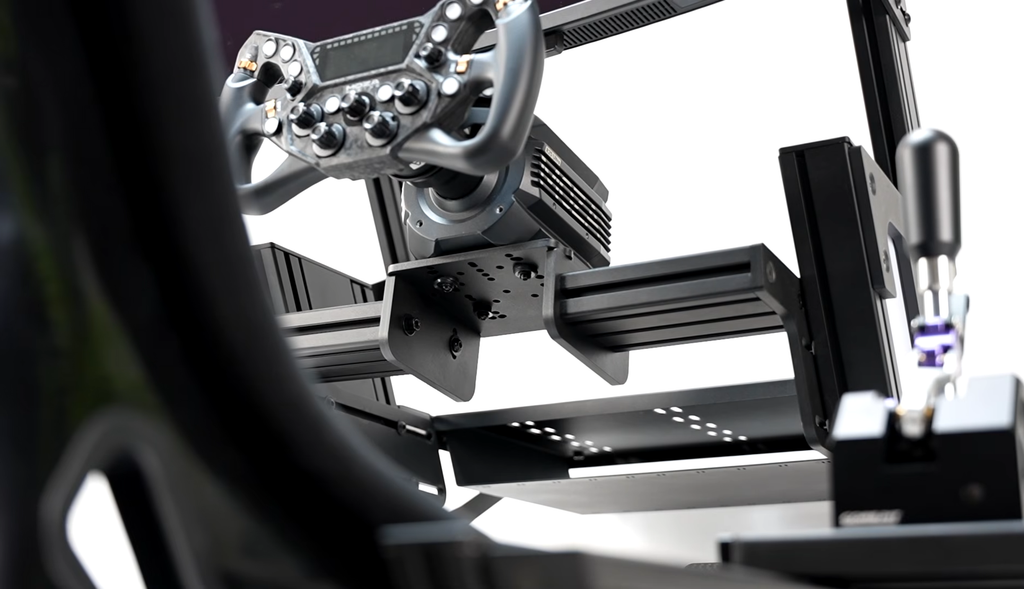
The strongest argument for the Series One is the construction. Everything feels massively overbuilt, starting with the wheel mount. It can be adjusted vertically, horizontally, and by angle, while front and bottom mounting options provide compatibility with a wide range of direct drive bases.
Once everything is tightened, there is basically no meaningful movement. I tested the cockpit with some powerful direct drive hardware and could not notice any significant flex from the wheel deck or uprights.
The pedal tray follows a similar design philosophy. Instead of one large plate covered with mounting holes, TrackTime uses adjustable aluminum rails that can be repositioned for different pedals. Height, angle, and distance can all be changed, and even with a stiff load cell brake, the assembly remained extremely solid.
The optional shifter mount is similarly substantial. Really, no matter where I pushed or pulled on this cockpit, there was very little noticeable movement. It is stupidly heavy and basically built like a tank, which is exactly what I want to see from something costing this much.
Push or pull anywhere and there is very little noticeable movement.
Adjustability and Accessories
The Series One retains one of the biggest advantages of a traditional profile cockpit, which is adjustability. The wheel, pedals, seat, shifter, and other accessories can all be positioned around the driver, while the profile sections provide plenty of mounting locations for additional hardware.
I particularly like the profile section incorporated into the wheel mount itself. It gives you an easy place to mount button boxes, wind simulators, or other accessories without needing another large bracket.
The optional PC tray also integrates neatly into the rear of the chassis and includes useful space underneath for managing cables. The single monitor mount works well too and follows the same clean design as the rest of the cockpit.
The TT07 Seat Is the Weak Point
The optional TrackTime TT07 seat does not quite match the rest of the cockpit. It is comfortable enough and I had no major issues during longer sessions, but at roughly €300, I think there are better alternatives.
The fabric can become fairly warm, and more importantly, the seat shell has noticeably more flex than the chassis underneath it. Under harder braking, I could feel some movement from the seat itself, which becomes much more obvious when everything surrounding it is almost completely rigid.
The seat brackets are excellent and provide a huge selection of mounting positions. Personally, though, I would configure the Series One with a more rigid seat and keep the rest of the cockpit exactly as it is.
How It Feels on Track
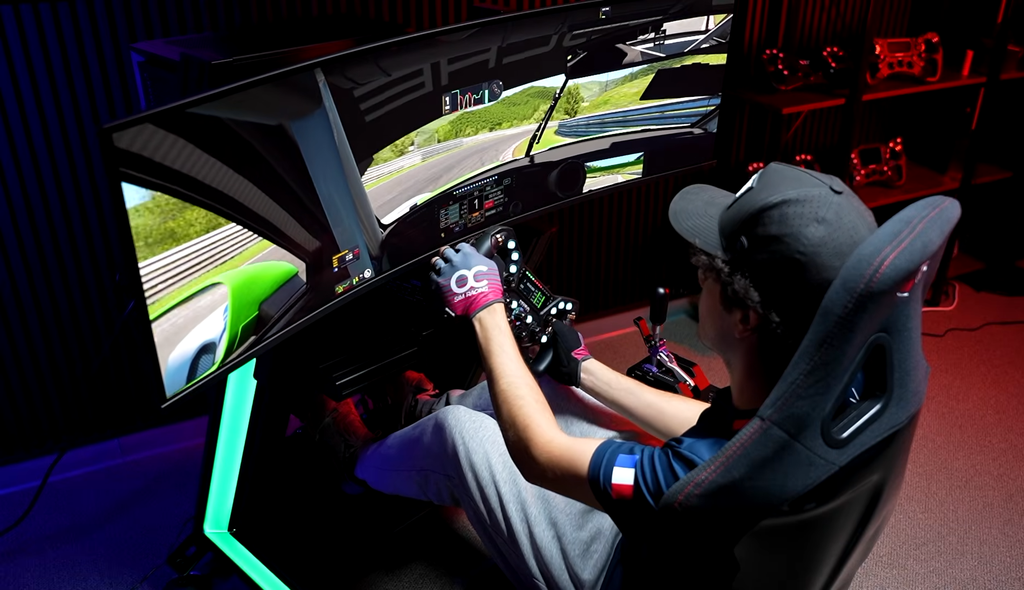
Once the driving position is properly adjusted, the Series One basically disappears underneath you. That is probably the best compliment I can give a sim racing cockpit.
The takeaway: Once set up, the Series One basically disappears underneath you. That is the best compliment a cockpit can get.
There is no distracting wheel deck movement, the pedals stay exactly where you put them, and the entire structure remains planted even when using stronger hardware. All of the effort that goes into the steel reinforcement and heavy construction becomes obvious once you start driving.
The powder-coated components can scratch more easily than I would like, and moving the cockpit around is not exactly fun because of the weight. Once it is installed where you want it, though, those problems become much less important.
No distracting wheel deck movement, and the pedals stay exactly where you put them.
Final Thoughts
The TrackTime Series One is not the obvious choice for most sim racers. If you simply want maximum rigidity and adjustability for the least amount of money, there are cheaper alternatives. If you want something simple that can be assembled quickly and forgotten about, I would probably look elsewhere too.
But I also do not think that is who this cockpit is designed for. The Series One makes more sense for someone already spending serious money on a simulator who wants the cockpit itself to become part of the overall build.
You are paying extra for the unusual design, hidden cable management, integrated lighting, ridiculous rigidity, and a cockpit that does not look like practically every other aluminum profile rig on the market. Whether those things justify the premium is going to be personal.
For someone looking for something different, extremely capable, and undeniably unique, the Series One makes a surprisingly strong case for itself. It is expensive and unnecessarily complicated in places, but it is also one of the most interesting sim racing cockpits I have used.
Final Verdict
Recommended if you want something different and undeniably unique, and you accept the premium.
Ideal buyer: Sim racers wanting something different and unique.
Major drawback: Complicated assembly and pricing that adds up fast.
Bottom Line: For someone looking for something different, extremely capable, and undeniably unique, the Series One makes a surprisingly strong case for itself.
Sim racing hardware reviewer and creator. Every review on this site is hands-on tested across direct-drive wheelbases, pedals, cockpits, motion systems and accessories before a word is published.
Simagic is finally preparing to reveal its long-awaited Active Pedal during its global product launch on October 14, nearly two years after the first prototype appeared.
Race Sim Studio has released the Formula Hybrid 2026 for Assetto Corsa, bringing active aerodynamics, a new 350 kW hybrid system, adaptive ERS deployment, and an extensive suite of racing…
Kunos Simulazioni has shared a detailed look at the future of Assetto Corsa EVO, outlining changes to the game's development direction and revealing more information about its long-awaited Free Roam…
Conspit CHS · $369 Conspit sent this product to me for review. Conspit has entered the shifter market with the CHS, a dual-mode shifter that combines a 7-gear H-pattern with…
After making its public debut in Chicago, Sim-Lab is bringing its upcoming Porsche 963 replica steering wheel to SimRacing Expo Frankfurt for another major showcase.
Gran Turismo 7 Spec IV Part 1 arrives October 15 with Sportsland SUGO, six new cars including the Ferrari F355, new Brand Central challenges, Car Concierge, Car Viewer and more.
The new Thrustmaster T-GT III brings Direct Axial Drive, 5 Nm of constant torque, load cell pedals, and dedicated Gran Turismo 7 haptics to PS5 and PS4.
The Circuit One D Force 1 packs four motion actuators into a suitcase, installs in about 10 minutes, and trades big travel for detail you can actually use.





TrackTime Series 1 Cockpit: Everything You Need to Know - OC Racing says:
[…] Official TrackTime Website Trusted Hardware Distributors Full Series One Review […]