Pimax supplied this sample at no cost, no money changed hands. They had no input on this article and did not see it before publication.
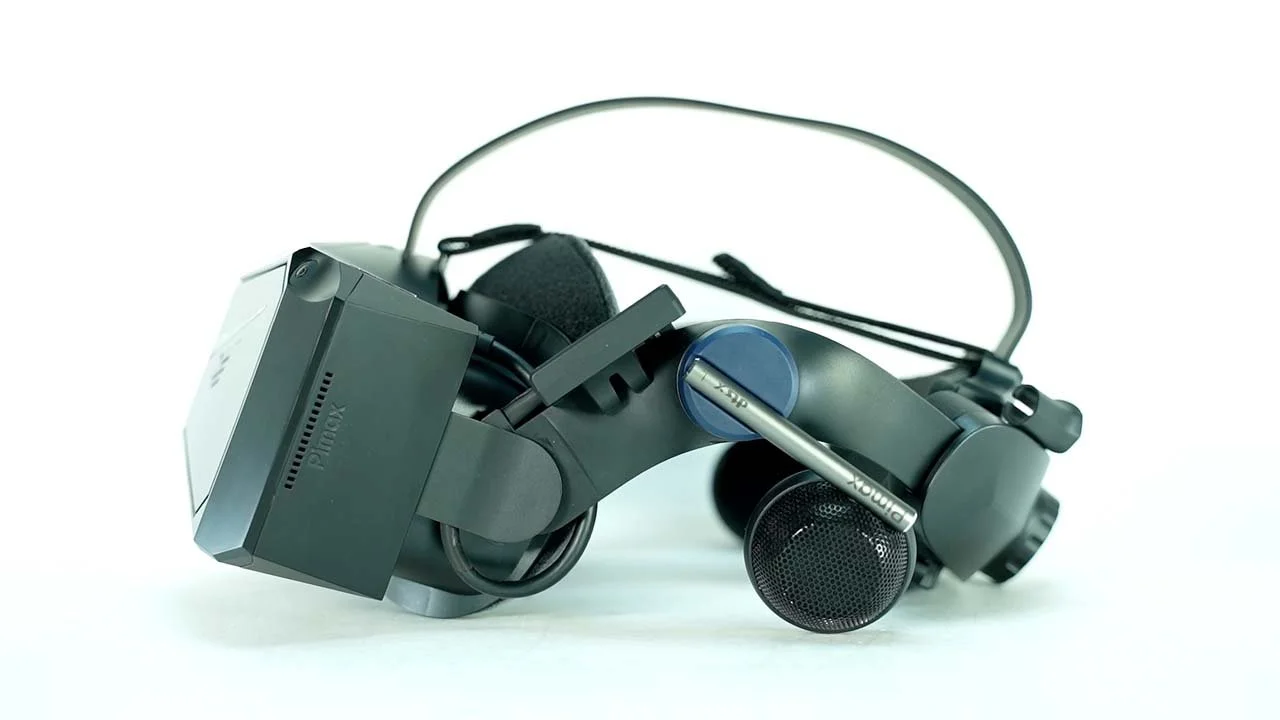
This is the Pimax Crystal VR headset, and anyone who regularly follows my content knows this isn’t the typical product I review. However, when Pimax reached out several months ago wanting to know if I would want to check this out, I figured it’s been several years since I’ve sim raced in VR and would be interested in seeing how the technology has advanced.
Packed with loads of technical features and stuff that I frankly don’t really specialize in, this review will be different from most in the sense that I’ll be talking about it solely in the context of sim racing, going over the good, the bad, and whether it’s any good for this specific application. For far more information regarding the controllers, software, installation, etc., I’d definitely recommend watching other reviews to get a more well-rounded understanding of everything offered by this headset, far more than just sitting down with a wheel in front of you.
OC RACING RECOMMENDED
Pimax Crystal
Premium VR headset with 2880×2880 per eye resolution and up to 120Hz refresh
VERDICT
A seriously impressive bit of kit and an easy recommendation for sim racers looking for the ultimate in-game immersion.
BEST FOR
Sim racers wanting ultimate in-game immersion
NOT FOR
Budget buyers, or racers who dislike front heavy headsets
WHAT I LIKE
2880×2880 per eye clarity with no visible pixels
Up to 120Hz refresh for smooth driving with limited motion sickness
Integrated tracking, no external base stations needed
WHAT I DON’T
Front heavy, with neck strain after 45 to 60 minutes
Needs external batteries, two included with a charging dock
Costs $1,450 without controllers, $1,600 with them
DURATION: Tested over several monthsSETUP: Installed with SteamVR, running in Assetto Corsa in minutesTITLES/EFFECTS TESTED: Assetto CorsaBENCHMARK: 2880×2880 per eye, 5760×2880 total, up to 120HzCOMPARED AGAINST: HTC Vive Pro, HP ReverbREVIEW UNIT: Supplied by Pimax at no cost
The takeaway: Exceptional clarity, FOV and speed make the Crystal an easy recommendation for sim racers chasing ultimate immersion.
Worth knowing: It is front heavy, so neck strain can build after 45 minutes to an hour, and it runs on external batteries.
Positives
The installation of this headset was straightforward, and using Steam VR, launching everything up in Assetto Corsa took no more than a few minutes and immediately I remembered how cool sim racing in VR is. However, as opposed to my previous VR experiences with headsets far older than this, the Pimax Crystal simply brought it to another level.
That’s because of two main reasons: one being the extremely high resolution paired with the headset’s fast refresh rate, two things that are extremely critical, especially for sim racing. With a per-eye resolution of 2880×2880 or 5760×2880 in total, no matter how hard I tried to focus on any one spot to notice any sort of pixels, I really couldn’t. It came to the point where any blurriness seen in-game was a result of limitations from Assetto Corsa rather than the hardware limitations of the headset itself. Coming from previously using an HTC Vive Pro and HP Reverb, this is where the Pimax Crystal seriously excelled. Seeing reflections, sun glares, and other details with no sort of low resolution ruining the immersion was extremely impressive.
Moreover, this headset can give out up to a 120Hz refresh rate, allowing for a buttery smooth on-track sensation with limited blurriness when blasting down the track. The difference in refresh rate was made especially noticeable when focusing on small things like light poles and on-track banners, which would look less jittery when flying by. Similarly, I also found it somewhat limited motion sickness as it provided a more realistic and smooth experience.
As opposed to my HTC Vive Pro which required external base station cameras to keep track of the headset’s motion, the Pimax Crystal has them all integrated into the headset itself. This not only makes it far more convenient and easy to use but also allowed for a completely uninterrupted driving experience as my seat or sim rig could never interfere with any type of signal.
Of course, everything I’ve said about this headset has been quite positive so far, and that’s because the in-game performance has been simply stunning. However, there are a few things I didn’t quite like, those of which are very much worth going over.
Negatives
For starters, this headset is significantly front-heavy, and after 45 minutes to an hour of straight use, I would begin to notice strain on my neck and would feel the need to take a break. This, of course, will vary for everyone but that’s around the time length that I begin to feel discomfort. Similarly, as I’ve complained about in the past, during very intense race situations when you begin to get hot and sweaty, having this strapped onto your face won’t be any help and is just something worth considering.
Another thing I did not like about the Pimax Crystal was the need to use external batteries to power the headset. Although two come included along with a charging dock, this will of course be an added hassle as you’ll need to keep an eye out for battery life, something I haven’t been used to doing.
Of course, it is worth noting that the price of this headset, without controllers, retails for $1,450 or $1,600 with the Pimax controllers. This is undoubtedly a massive price and without a doubt something worth keeping in mind.
Conclusion
All in all, though, you certainly are getting what you pay for. Out on the track, both the clarity, FOV, and speed of this headset have been exceptional, and it’s for that reason that throughout the last few months that I’ve been using it, I’ve found myself enjoying my time with this far more than with my triple monitors. Of course, in that sense, there are a ton of pros and cons when it comes to triples VS VR, and I’ll be making a separate video soon talking about just that.
So overall, the Pimax Crystal VR headset is a seriously impressive bit of kit and is an easy recommendation for sim racers looking for the ultimate in-game immersion. Though this review is far from the most detailed when it comes to the technical specifications and true gaming performance of this hardware, what I can say is that specific for sim racing applications, it undoubtedly excels.
What are the standout features of the Pimax Crystal VR headset? Key features include a high per-eye resolution of 2880×2880, a total resolution of 5760×2880, and a refresh rate of up to 120Hz. It also has integrated motion tracking cameras, which enhance convenience and user experience.
What are some downsides of the Pimax Crystal VR headset? Some drawbacks include its front-heavy design, which might cause neck strain after extended use, and the need to use external batteries for power, adding extra maintenance.
What is the price of the Pimax Crystal VR headset? The headset costs $1,450 without controllers and $1,600 with Pimax controllers. This price point reflects its premium features and performance.
What makes the Pimax Crystal VR headset different from older VR headsets like the HTC Vive Pro? Compared to older models like the HTC Vive Pro, the Pimax Crystal offers significantly better resolution and refresh rates, integrated motion tracking without the need for external base stations, and overall superior visual clarity and smoothness.
Is the Pimax Crystal comfortable for long gaming sessions? Due to its front-heavy design, some users may experience neck strain after 45 minutes to an hour of use. This varies by individual, and breaks are recommended during long sessions.
FINAL VERDICT
Recommendation: An easy recommendation for sim racers looking for the ultimate in game immersion, if the budget stretches to it.
Ideal buyer: Sim racers who want maximum clarity, wide FOV and smooth 120Hz VR racing.
Major drawback: Front heavy build that can strain your neck after 45 minutes to an hour of use.
Bottom Line: You get what you pay for: exceptional clarity, FOV and speed at a premium $1,450 price.
Sim racing hardware reviewer and creator. Every review on this site is hands-on tested across direct-drive wheelbases, pedals, cockpits, motion systems and accessories before a word is published.
Simagic is finally preparing to reveal its long-awaited Active Pedal during its global product launch on October 14, nearly two years after the first prototype appeared.
Race Sim Studio has released the Formula Hybrid 2026 for Assetto Corsa, bringing active aerodynamics, a new 350 kW hybrid system, adaptive ERS deployment, and an extensive suite of racing…
Kunos Simulazioni has shared a detailed look at the future of Assetto Corsa EVO, outlining changes to the game's development direction and revealing more information about its long-awaited Free Roam…
Conspit CHS · $369 Conspit sent this product to me for review. Conspit has entered the shifter market with the CHS, a dual-mode shifter that combines a 7-gear H-pattern with…
After making its public debut in Chicago, Sim-Lab is bringing its upcoming Porsche 963 replica steering wheel to SimRacing Expo Frankfurt for another major showcase.
Gran Turismo 7 Spec IV Part 1 arrives October 15 with Sportsland SUGO, six new cars including the Ferrari F355, new Brand Central challenges, Car Concierge, Car Viewer and more.
The new Thrustmaster T-GT III brings Direct Axial Drive, 5 Nm of constant torque, load cell pedals, and dedicated Gran Turismo 7 haptics to PS5 and PS4.
The Circuit One D Force 1 packs four motion actuators into a suitcase, installs in about 10 minutes, and trades big travel for detail you can actually use.