If you have just started playing iRacing, the good news is that getting better is not some mystery. The bad news is that a lot of beginners focus on the wrong things first. They chase one magical fast lap, rely too heavily on assists, overdrive the car, and then wonder why the results are inconsistent or why racing online feels chaotic. That is all normal at first, but it is also exactly why building the right habits early matters so much.
So if you are new and want the quick version of how to get good at iRacing, here it is. These are five simple steps that will help you improve faster, race cleaner, and build the kind of fundamentals that actually carry over as you move up through the license classes. None of this is flashy, but that is kind of the point. The basics are what make people good.
1. Focus on consistency before outright speed
The first thing I would tell any beginner is to stop obsessing over one fast lap. In iRacing, being able to hit the same braking points, follow similar lines, and repeat your inputs lap after lap is far more valuable than pulling one hero lap out of nowhere and then spending the next five laps making mistakes. That kind of consistency is what actually builds race pace, and more importantly, it is what gives you something stable to improve from.
A lot of newer drivers confuse speed with progress. They see a quick lap time and assume they are figuring it out, but if the next five laps are all over the place, then not much has really been learned. Real improvement comes when your laps start looking the same. Once you can repeatedly do the same thing, then you can start finding time in a much more deliberate way. That is when getting faster starts becoming real rather than accidental.
This also matters in races more than people realize. Most beginner races are not won because someone found half a second of magical pace. They are often won because someone simply stayed on track, avoided mistakes, and kept doing the basics properly. Consistency is not only safer, it is faster over the course of an actual race.
2. Turn off the racing line as soon as possible
I know this one can sound harsh when you are brand new, but I really do think you should turn off the racing line as soon as you realistically can. It may feel helpful at first, and to be fair, it can make the first few laps around a totally unfamiliar circuit a little less overwhelming, but long term it holds you back. If you rely on it too much, you never really learn the track properly.
The problem with the racing line is that it encourages passive driving. You end up following a floating guide instead of actually reading the circuit. You stop thinking about the corners, the shape of the track, the elevation, and the visual cues around you, because the game is doing too much of that work for you. Then the moment you are in a real race with traffic, pressure, and changing situations, that floating line stops being very useful anyway.
Turning it off forces you to become more engaged with the track itself, and that is exactly what you want. It makes you look further ahead, think more actively, and build real awareness. At first that may feel harder, but that difficulty is part of the learning. In the long run, it makes you a much better driver.
3. Use real visual reference points
Once the racing line is gone, the next step is learning how to replace it properly. That means using actual visual reference points around the circuit. Braking boards, changes in curbing, shadows, fencing, marshal posts, patches in the asphalt, and even specific trees or signs can all become useful markers depending on the track. These are the things good drivers rely on, because they are fixed, repeatable, and grounded in the circuit itself.
This is one of the biggest differences between someone who is just driving around and someone who is actually learning. A driver who knows their references is much more likely to be repeatable under pressure. They know where to brake, where to turn in, and what parts of the track they can trust. That makes it easier to stay calm and easier to adjust when conditions change.
It also helps you improve with more purpose. If you know you usually brake at the 100 board, then later you can test whether braking a touch later works. If you know exactly where you want to turn in, then you can judge whether your entry is too tight or too wide. Without those references, you are mostly guessing. And guessing is not a great long-term strategy in iRacing.
4. Prioritize clean racing over everything else
One of the best things you can do early on is care more about racing cleanly than trying to force every overtake and every result. That is not a boring answer, it is a very practical one. In iRacing, cleaner racing improves your Safety Rating, and that matters because it moves you toward cleaner lobbies with drivers who are generally more controlled and more enjoyable to race against.
A lot of beginners get themselves into trouble because they treat every corner like the race depends on it. They force low-percentage moves, defend too aggressively, or overpush in situations where simply surviving would have been the smarter option. That usually ends with contact, frustration, and a worse experience for everyone involved. Clean racing is not just good etiquette, it is one of the smartest ways to progress.
And the nice thing is that clean drivers usually end up becoming better drivers anyway. They learn patience, spatial awareness, and risk management much earlier. They start understanding when to fight, when to wait, and when to let a race come to them. Those are very important skills in iRacing, especially once the competition gets stronger.
5. Drive different cars and tracks to become more adaptable
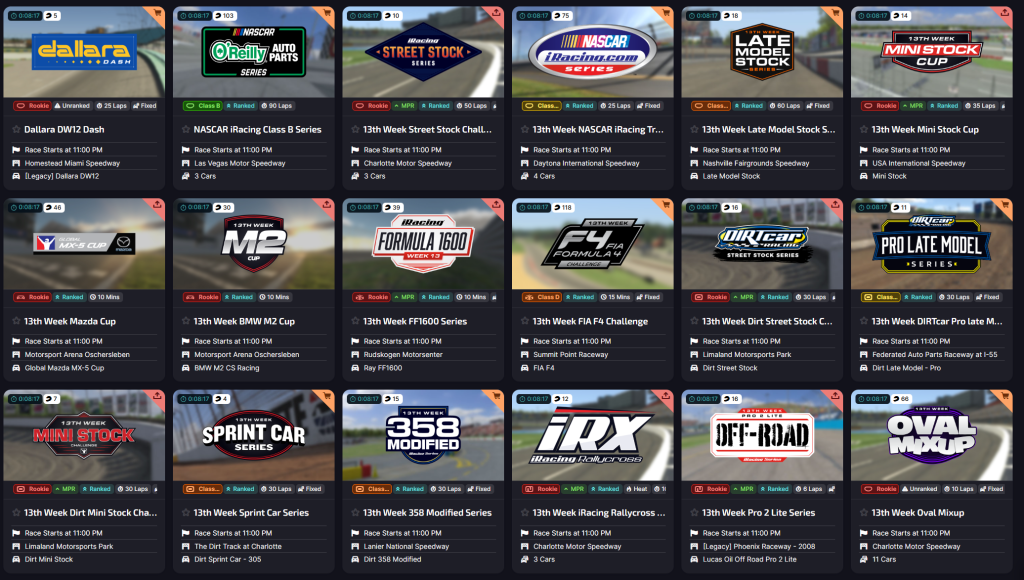
It is very easy in iRacing to find one car you like, one series you feel comfortable in, and then stay there forever. And while there is nothing wrong with specializing later on, as a beginner I think it is a really good idea to experiment with the free cars and tracks iRacing gives you. Variety is one of the fastest ways to expose weaknesses in your technique and build a broader set of driving skills.
Different cars teach you different things. A slower rookie car might help you understand momentum and smoothness. A heavier or more powerful car might punish bad throttle application. A different track layout may reveal that your braking technique is less stable than you thought. All of that is useful. It forces you to adapt, and adaptability is a huge part of getting good in this sim.
This also helps prevent you from building very narrow habits. If you only ever drive one car in one style, you may feel quick there but weak everywhere else. Mixing things up broadens your understanding of vehicle behavior and makes you a more rounded driver over time. It is not about becoming amazing in everything instantly. It is about not limiting your growth too early.
Final thoughts
If you are new to iRacing, the best advice I can give is to build good habits before you worry about looking fast. Focus on consistency, turn off the racing line, use proper references, race cleanly, and spend time driving a variety of cars and tracks. Those five things will take you much further than chasing one lucky lap or trying to force progress before the fundamentals are there.
And yes, as a final bonus tip, maybe get a second job to help fund your iRacing career. That part is only half a joke. But seriously, if you stick to the right habits early, the whole experience becomes much more fun, much more rewarding, and a lot less frustrating. That is really what you want from the start.
Kunos Simulazioni has shared a detailed look at the future of Assetto Corsa EVO, outlining changes to the game's development direction and revealing more information about its long-awaited Free Roam…
Conspit CHS · $369 Conspit sent this product to me for review. Conspit has entered the shifter market with the CHS, a dual-mode shifter that combines a 7-gear H-pattern with…
After making its public debut in Chicago, Sim-Lab is bringing its upcoming Porsche 963 replica steering wheel to SimRacing Expo Frankfurt for another major showcase.
Gran Turismo 7 Spec IV Part 1 arrives October 15 with Sportsland SUGO, six new cars including the Ferrari F355, new Brand Central challenges, Car Concierge, Car Viewer and more.
The new Thrustmaster T-GT III brings Direct Axial Drive, 5 Nm of constant torque, load cell pedals, and dedicated Gran Turismo 7 haptics to PS5 and PS4.
The Circuit One D Force 1 packs four motion actuators into a suitcase, installs in about 10 minutes, and trades big travel for detail you can actually use.
Assetto Corsa EVO Update 0.9 introduced a major overhaul to the game's GT tyre model, changing how cars behave around the limit across a wide range of GT machinery.
Project Motor Racing has received its Version 2.3 update, bringing the Lamborghini Temerario to the simulator alongside a new vehicle class, physics revisions, visual improvements and a series of changes…