The Simucube 3 Pro is one of those products that carries a serious amount of weight before you even touch it. Simucube has been one of the most respected names in sim racing for years, and when a brand like that releases a new high-end wheelbase, expectations are naturally massive. People expect premium build quality, top-tier force feedback, and the kind of driving experience that reminds you why this end of the market exists in the first place.
And in some ways, the Simucube 3 Pro absolutely delivers on that. But at the same time, this is also one of the more controversial wheelbases in the current high-end market. Not because it drives badly, because it definitely does not, but because the overall product story is far more complicated than the force feedback alone might suggest. So if you want the quicker version of what the Simucube 3 Pro is all about, here is everything you need to know before buying one.
Simucube 3 Pro Direct Drive Wheelbase
An elite driving experience wrapped inside a product that is more closed, more expensive and more complicated than its rivals.
Best for Buyers building a high-end setup from scratch inside Simucub
The Simucube 3 Pro is the middle option in the Simucube 3 lineup, sitting between the Sport and the Ultimate. It is the 25 Nm version, which means it is aimed directly at the serious end of the sim racing market. This is not an entry-level wheelbase, not a mid-range value play, and definitely not something most people will casually stumble into. It is designed for the buyer who already knows they want premium hardware and is willing to spend serious money to get it.
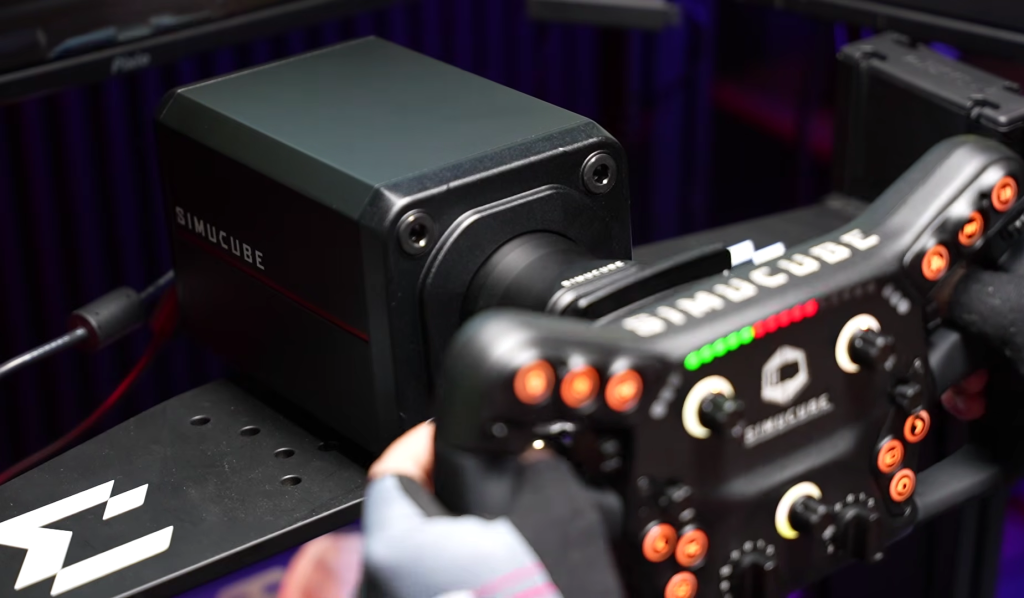
From a physical hardware perspective, it feels exactly like something in that category should. It is heavy, full metal, and very industrial in its design, with that familiar orange Simucube accent that has become so recognizable. Even though it feels like an absolute unit, the base itself is still fairly compact for what it is, which does help when it comes to mounting and rig fitment. That is a nice little bonus.
And that is worth pointing out early, because there is very little to complain about in terms of how the product feels in your hands. It is rigid, refined, and properly premium. You pick it up and immediately understand that this is a serious bit of kit.
Build quality is excellent, and the quick release is mechanically great
One of the clearest strengths of the Simucube 3 Pro is simply how well built it is. The construction is excellent, and the base carries itself with the kind of confidence you would expect from a flagship-style product. There is no looseness, no cheapness, and no sense that anything here was done halfway. It feels expensive, and in fairness, it should.
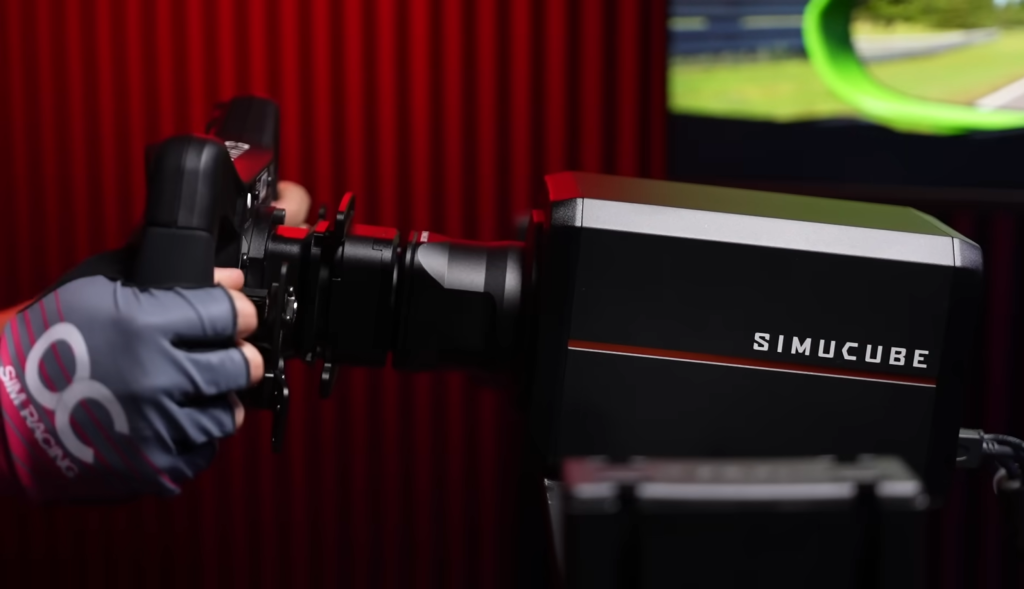
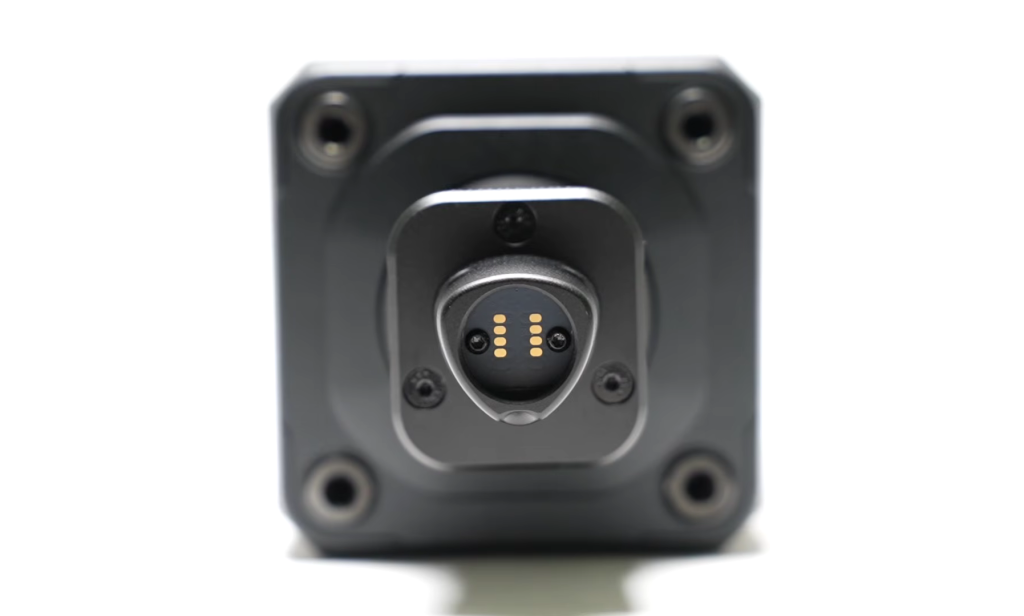
The same applies to the new proprietary quick release. Mechanically, it is excellent. Once mounted, it feels extremely secure, with no real flex or unwanted movement even when you really try to pull against it. In terms of pure fit and rigidity, it does exactly what you would want a modern high-end quick release to do. So from a purely physical and mechanical perspective, Simucube has absolutely delivered here.
And that is part of what makes this wheelbase such an interesting product. It is not controversial because it feels poorly made. Quite the opposite. It feels very polished in the most obvious ways. The issue is everything that starts happening around that hardware.
The ecosystem is where the problems begin
This is where the conversation changes. While the quick release itself is mechanically excellent, it is also proprietary, and that is one of the biggest reasons why the Simucube 3 Pro has become such a debated product. Simucube has clearly pushed this base into its newer ecosystem strategy, and that means the ownership experience is not nearly as open or as simple as many people would probably expect at this price point.
If you already own a collection of third-party USB wheels, they can still work, but not in the clean way many people would hope for. Instead of everything being handled neatly through the base, those wheels still need their own separate USB connection directly to the PC because there is no USB pass-through here. And honestly, for a wheelbase at this level, that is a frustrating omission. Especially when many competing high-end bases, and even cheaper ones, manage to offer a more flexible setup experience.
Then there is the mounting standard. A lot of existing wheels use a standard 70 mm pattern, while Simucube’s newer system uses a 50 mm connection. So depending on what you already own, adapters may become part of the story too. That means more cost, more friction, and more evidence that this wheelbase is much easier to recommend to someone building from scratch than to someone already invested in a broader collection of hardware.
Lightbridge is clever, but only really helps the right buyer
To be fair, Simucube is not doing this for no reason. The company has built what it calls a contactless data and power system through its newer ecosystem, and from a technical standpoint, that is genuinely impressive. The idea is that with the right compatible wheel, you get a cleaner and more integrated connection experience without the usual cable clutter. Technically, that is very cool, and it is one of the more interesting ideas in the premium wheelbase market.
The problem is that this only really becomes a benefit if you are fully buying into that ecosystem. And for a lot of people, that is the catch. If you already own older or third-party wheels, then a lot of that cleverness becomes much less useful in real life. So while the technology itself is impressive, the practical value of it depends very heavily on whether you are willing to build your whole setup around Simucube’s new direction.
That is why the base ends up feeling a little less open than it probably should. It is not that the technology is bad. It is that the advantages only really become advantages if you are the exact kind of buyer Simucube seems to want. For everyone else, it can feel more like added complication than added value.
The Link box makes the overall package harder to love
Another important thing to know is that the Simucube 3 Pro does not feel as simple to set up as it probably should for the money. In order to make the system work on PC, you also need the separate Link box. That means another required component, another cable, another thing to mount, and another extra cost on top of what is already an expensive wheelbase.
And this is one of the hardest parts to ignore. Once you factor in that extra box, the real cost of the Simucube 3 Pro climbs even higher, to the point where it ends up more expensive than basically every other 25 Nm wheelbase on the market. Even if there are technical reasons for that design, and I am sure there are, it is still difficult from a buyer’s perspective not to feel like something this essential should simply have been included in the box from the start.
That is really the recurring story with this base. A lot of the controversial parts are not about the raw driving experience. They are about friction. Extra boxes, extra adapters, extra cost, extra thought. And when you are spending this much money, you generally want fewer headaches, not more.
At $1,125.08 this is its usual price.
The lowest we have recorded is $1,074.10 on 10 Oct 2026.
On track, it is genuinely excellent
Now, with all of that said, this is where the Simucube 3 Pro reminds you why the brand still has the reputation it does. Because once you actually get out on track with it, the force feedback is genuinely outstanding. And I do not mean merely good for the torque or good for the price. I mean right at the top in terms of overall feel.
What makes it so impressive is not just strength. Plenty of high-end bases are strong now. What stands out here is the way the torque is delivered. Everything feels clean, immediate, controlled, and highly detailed without ever becoming harsh or artificially busy. It is rapid when it needs to be, but still smooth and believable in a way that feels deeply connected to the car rather than simply aggressive for the sake of impressing you.
If I had to describe the force feedback in one word, it would probably be polished. That really is the best way I can put it. It feels refined in a very complete way, and that is what makes it easy to understand why Simucube still has the reputation it does. As a driving tool, this thing is superb.
The included control module is also a genuinely nice touch. It makes on-the-fly adjustments very easy, doubles as a power button and emergency stop, and adds a bit of day-to-day usability that I appreciated a lot. The software is solid too. It is not especially flashy, but it is intuitive enough and does what it needs to do.
Final thoughts
The Simucube 3 Pro is one of the best wheelbases I have ever used in terms of raw driving feel. The force feedback is polished, detailed, smooth, and deeply impressive. If you are judging it purely as a driving tool, it absolutely deserves to sit near the very top.
But in 2026, a wheelbase is not only about force feedback. Ecosystem matters, compatibility matters, included hardware matters, and value matters. That is why the Simucube 3 Pro ends up being a brilliant wheelbase, but not necessarily a universally brilliant product. It delivers an incredible experience behind the wheel, but it does so inside a product strategy that feels more closed, more expensive, and more complicated than it probably should.
And really, that is the whole story. The Simucube 3 Pro is an elite driving experience wrapped inside a product that asks more of the buyer than many of its rivals do. For the right person, that will still be worth it. For everyone else, it is something you need to think about much more carefully.
Simagic is finally preparing to reveal its long-awaited Active Pedal during its global product launch on October 14, nearly two years after the first prototype appeared.
Race Sim Studio has released the Formula Hybrid 2026 for Assetto Corsa, bringing active aerodynamics, a new 350 kW hybrid system, adaptive ERS deployment, and an extensive suite of racing…
Kunos Simulazioni has shared a detailed look at the future of Assetto Corsa EVO, outlining changes to the game's development direction and revealing more information about its long-awaited Free Roam…
Conspit CHS · $369 Conspit sent this product to me for review. Conspit has entered the shifter market with the CHS, a dual-mode shifter that combines a 7-gear H-pattern with…
After making its public debut in Chicago, Sim-Lab is bringing its upcoming Porsche 963 replica steering wheel to SimRacing Expo Frankfurt for another major showcase.
Gran Turismo 7 Spec IV Part 1 arrives October 15 with Sportsland SUGO, six new cars including the Ferrari F355, new Brand Central challenges, Car Concierge, Car Viewer and more.
The new Thrustmaster T-GT III brings Direct Axial Drive, 5 Nm of constant torque, load cell pedals, and dedicated Gran Turismo 7 haptics to PS5 and PS4.
The Circuit One D Force 1 packs four motion actuators into a suitcase, installs in about 10 minutes, and trades big travel for detail you can actually use.