
Sim Gaming Expo 2026 - Chicago, Sept 18–20
North America's first expo for sim racing, flight & VR. Test the latest gear, meet the creators, score show-only deals. Schaumburg, Chicago - September 18–20.

Simagic has developed one of the strongest and most complete ecosystems in sim racing. The company now offers several wheel bases, steering wheels, pedals, shifters, handbrakes, and accessories covering a wide range of prices. I have used quite a few of these products over the years, but three stand out to me more than the rest.
My personal favorites are the Simagic GT Neo, P1000 pedals, and DS-8X shifter. These are not necessarily the most expensive products Simagic makes, but each one offers a strong combination of performance, functionality, and value. More importantly, these are products I have genuinely enjoyed using.
Verified purchase options at lowest current prices:
Editorial policy and disclosure
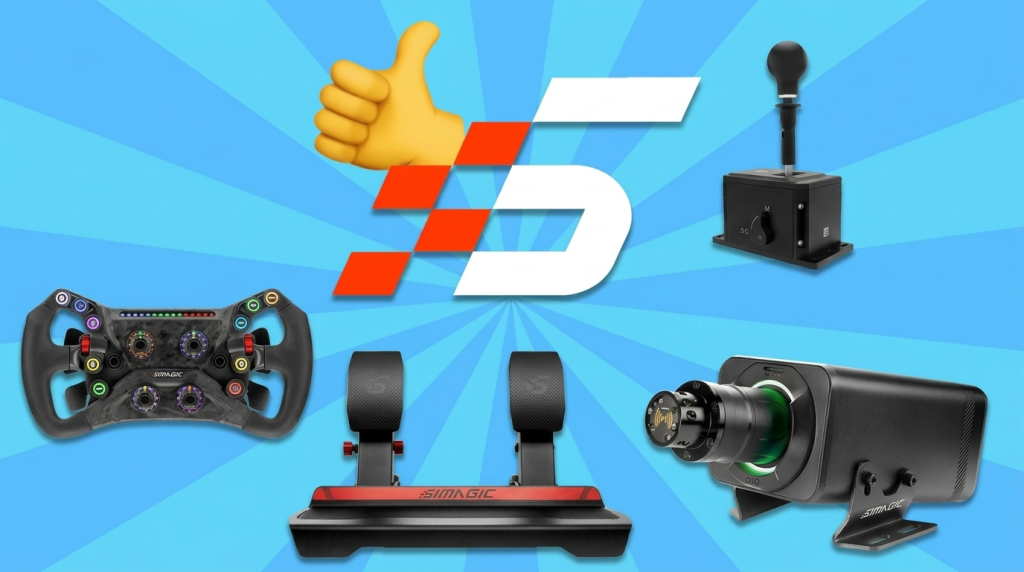
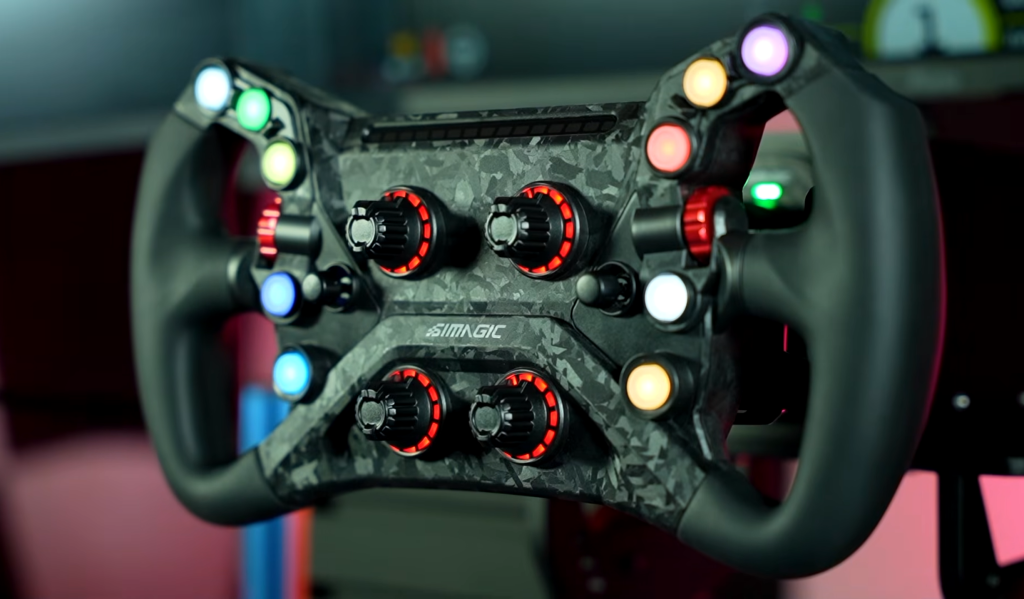
For starters, I have to mention the Simagic GT Neo. At $289, it remains one of the best-value GT-style steering wheels currently available. It gives you a large number of inputs, distinctive styling, useful lighting, and decent overall construction without moving into the much higher prices normally associated with this type of wheel.
The GT Neo has a modern butterfly-style shape that works especially well for GT cars, prototypes, touring cars, and some open-wheel vehicles. Its compact size makes the controls easy to reach, while the lightweight construction helps it remain responsive when paired with a direct drive wheel base.
There is plenty of functionality available. You get multiple buttons, rotary encoders, thumb controls, magnetic paddle shifters, and customizable RGB lighting. That gives you enough inputs for functions such as brake bias, traction control, ABS, pit limiter, radio, and display adjustments without needing to reach for a keyboard.
The overall build quality is good for the price. It does not feel as substantial as Simagic’s more expensive wheels, and there are certainly more premium alternatives available, but nothing about it feels unacceptable within this price range. The wheel remains rigid in normal use, the controls are satisfying, and the design makes it look more expensive than it actually is.
My main criticism is the grip material. The grips can become surprisingly slippery once your hands get even slightly sweaty. This is less noticeable when wearing gloves, but it can become distracting when driving with bare hands. A grippier material would make the GT Neo considerably better.
Even with that issue, the GT Neo continues to impress me. It delivers a lot of functionality for $289 and remains one of the easiest Simagic products to recommend. For anyone looking for an affordable GT-style wheel that still feels capable and complete, this is probably where I would start.
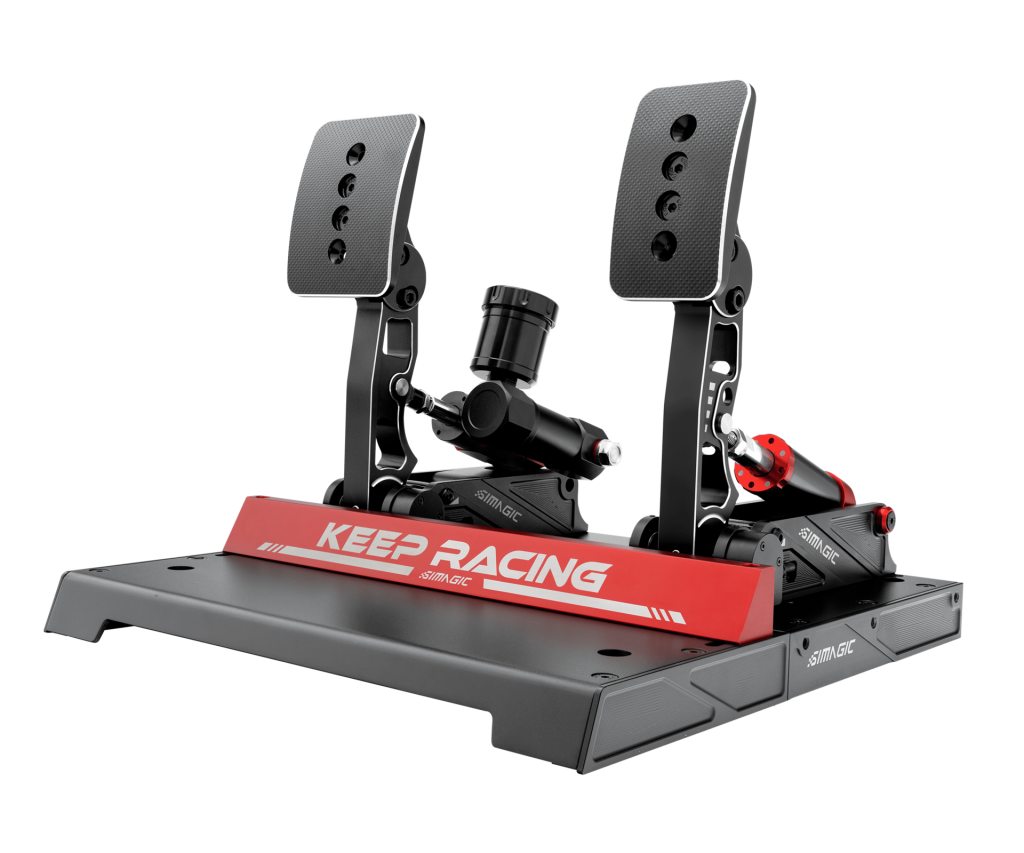
Next are the Simagic P1000 pedals. These stand out because of how versatile and expandable they are. The basic platform already offers excellent construction, strong adjustability, and a convincing pedal feel, but the wider range of optional upgrades is what makes the P1000 system especially interesting.
The pedals use a mostly metal construction and feel extremely rigid once mounted properly. You can adjust their positioning, travel, resistance, and several other characteristics to better suit your seating position and personal preference. This gives you plenty of control over the final setup, though it can also mean spending a fair amount of time finding settings that feel right.
That setup process is probably the biggest challenge. The P1000 pedals did not immediately feel perfect for me, and they required some experimentation before I was fully comfortable with them. Brake stiffness, pedal travel, spacing, and software calibration all make a noticeable difference. Once everything is properly adjusted, however, they become genuinely impressive pedals.
The upgrade options are another major advantage. Simagic offers hydraulic components, additional springs and elastomers, and haptic motors that can be mounted directly to the pedals. These upgrades let you gradually expand the system instead of replacing the entire pedal set as your expectations grow.
The haptic motors are especially useful because they can communicate effects such as ABS activation, traction control, wheel slip, and other telemetry-based information. That feedback can make the pedals feel more connected to the car and gives you information that would otherwise only come through the steering wheel or audio.
The P1000 pedals are not completely effortless to set up, but they reward the time spent adjusting them. They offer excellent build quality, plenty of customization, and one of the better upgrade paths in their price range. For someone who wants a pedal system that can develop alongside the rest of their simulator, they are a very strong option.
| Shop | Price | |
|---|---|---|
| Trak Racer | $469.00 | Buy |
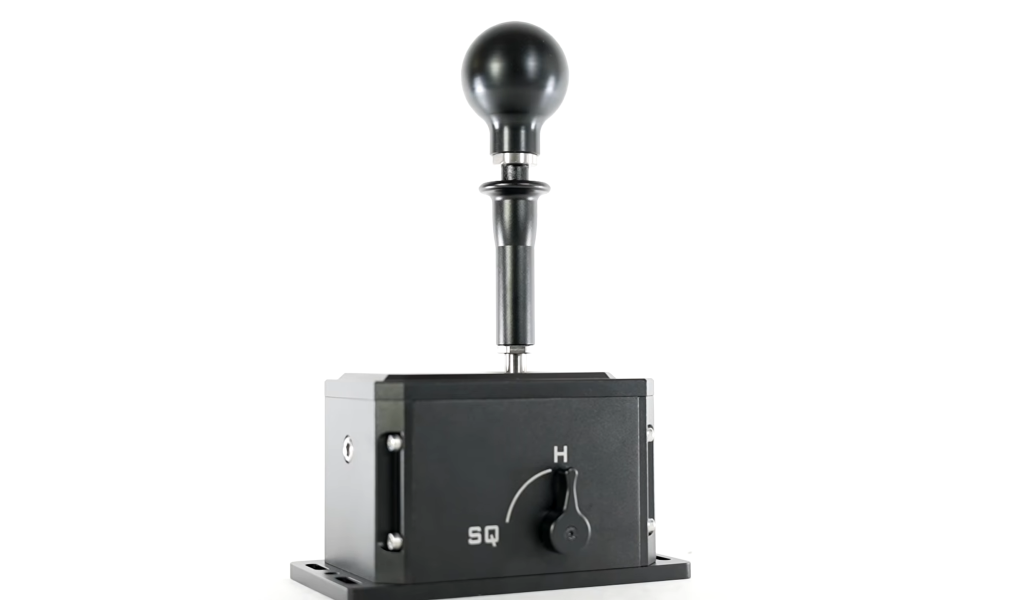
Finally, my third choice is the Simagic DS-8X shifter. This is one of my favorite H-pattern shifters because it feels satisfying, offers useful adjustment, and can quickly switch between H-pattern and sequential operation.
That dual-mode functionality makes it useful across a wide variety of cars. H-pattern mode works well for road cars, older race cars, and traditional manual transmissions. Sequential mode is better suited to rally cars, touring cars, and vehicles that use a simple forward and backward shifting motion.
Switching between the two modes is straightforward and does not require rebuilding the mechanism. That means you can move from one type of car to another without needing two separate shifters or spending a long time reconfiguring the hardware.
The shift resistance can also be adjusted, allowing you to make the action lighter or heavier depending on your preference. It has a satisfying mechanical feeling and provides enough definition between the gates to make shifting enjoyable. It cannot replicate every real transmission, but it adds a convincing physical element to cars that benefit from manual shifting.
Reliability is another reason the DS-8X makes my list. Some H-pattern shifters can develop issues with missed inputs, looseness, or inconsistent gear detection over time. At least in my experience, the DS-8X has remained dependable and has handled regular use without giving me any major problems.
It is a more specialized product than the GT Neo or P1000 pedals, since many modern race cars do not use a separate shifter. Still, for anyone who enjoys driving road cars, classics, rally cars, or older race cars, the DS-8X adds a huge amount of enjoyment and immersion.
| Shop | Price | |
|---|---|---|
| Trak Racer | $299.00 | Buy |
The GT Neo, P1000 pedals, and DS-8X shifter are my three favorite products from Simagic’s current lineup. The GT Neo offers an impressive amount of functionality and style for $289, the P1000 pedals provide excellent adjustability and a strong upgrade path, and the DS-8X delivers a satisfying and reliable dual-mode shifting experience.
All three have some drawbacks. The GT Neo grips can become slippery, the P1000 pedals require time to properly adjust, and the DS-8X will only make sense for people who regularly drive cars that need a separate shifter. Even so, each product performs its intended job very well and offers something genuinely useful within the Simagic ecosystem.
There are more expensive alternatives in every category, but these are the Simagic products that continue to stand out most to me. They offer the right balance of quality, functionality, and value, and they are the three pieces of Simagic hardware I would be most comfortable recommending.