
Sim Gaming Expo 2026 - Chicago, Sept 18–20
North America's first expo for sim racing, flight & VR. Test the latest gear, meet the creators, score show-only deals. Schaumburg, Chicago - September 18–20.

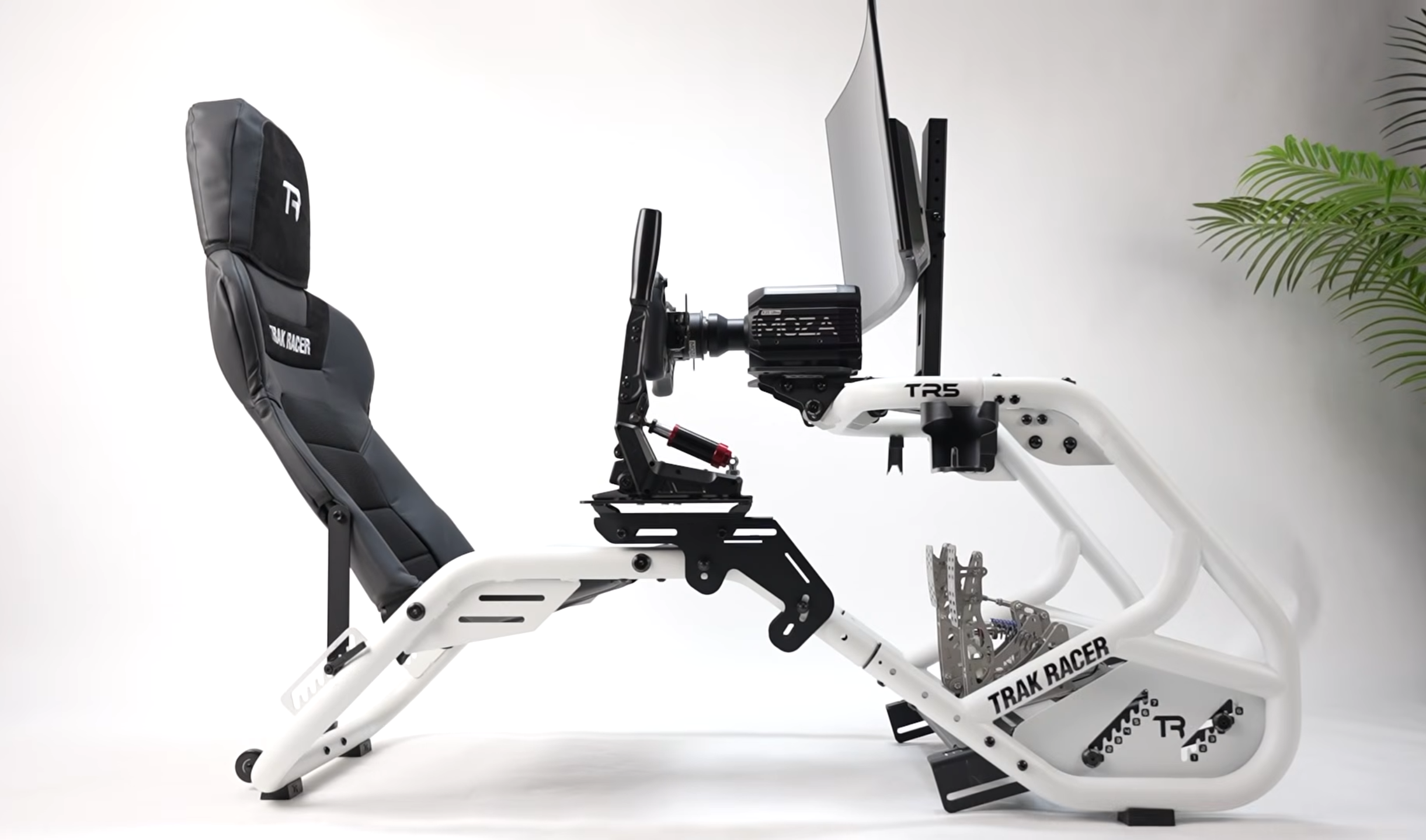
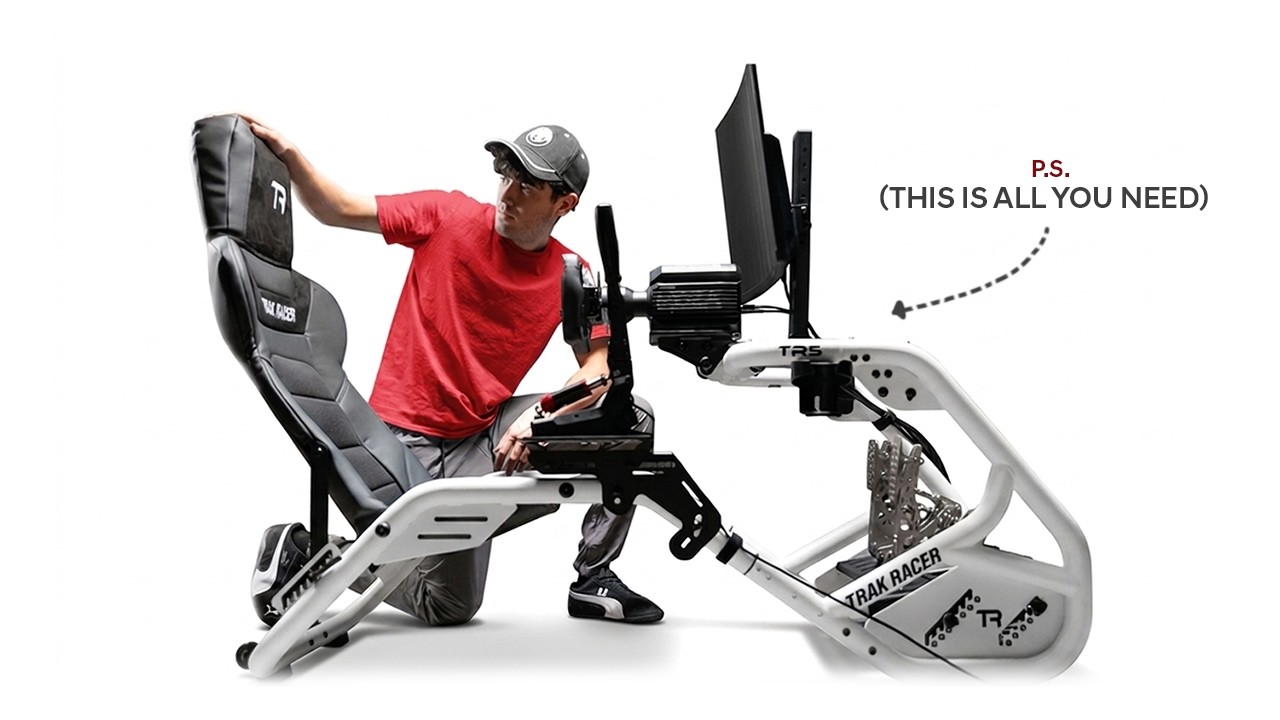
The Trak Racer TR5 is a complete sim racing cockpit aimed primarily at beginner and mid-range users who want something more substantial than a wheel stand without immediately jumping into a large aluminum profile rig.
For $599, you get the chassis, reclining seat, wheel deck, pedal tray, and shifter mount in one package. I have also spent several months using the TR5 with hardware considerably more powerful than what most people will realistically pair with it, which gives a pretty good idea of where its limitations actually are.
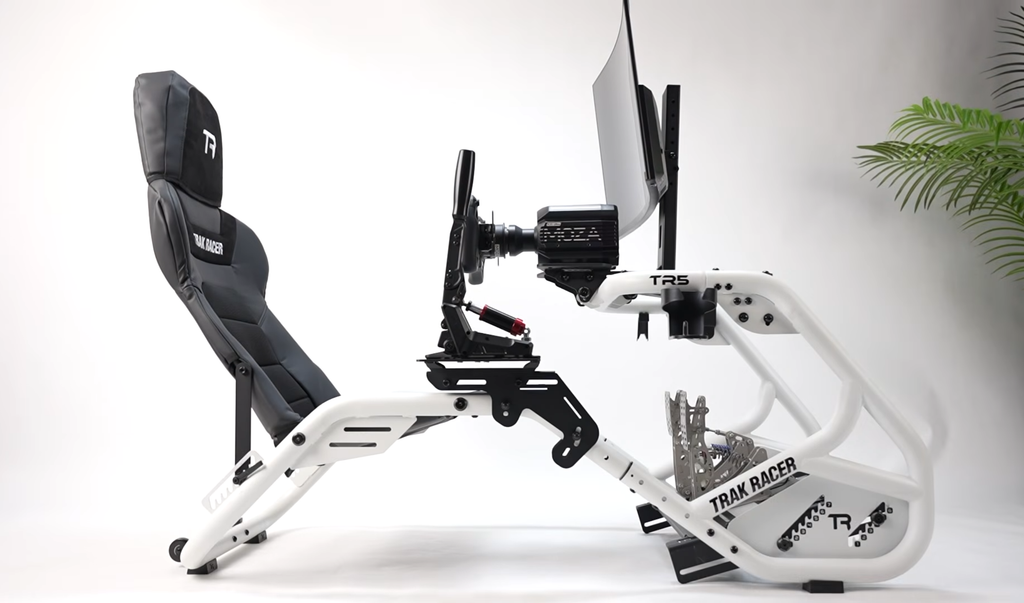
The TR5 retails for $599 with the seat and chassis included. That is one of the biggest reasons the cockpit is interesting, considering a decent sim racing seat alone can easily cost several hundred dollars once brackets and sliders are added.
The main chassis uses tubular carbon steel construction with a white finish. Included with the package are the reclining seat, pedal tray, wheel mount, shifter and handbrake mount, rubber feet, cable ties, and the hardware required for assembly.
Assembly itself is also relatively straightforward. Compared with a large aluminum profile cockpit made from dozens of individual pieces, the TR5 is much easier to put together and get driving.
Adjustability is surprisingly extensive for a tubular cockpit. The center of the chassis can extend or contract, allowing the overall length to accommodate a fairly wide range of driver heights.
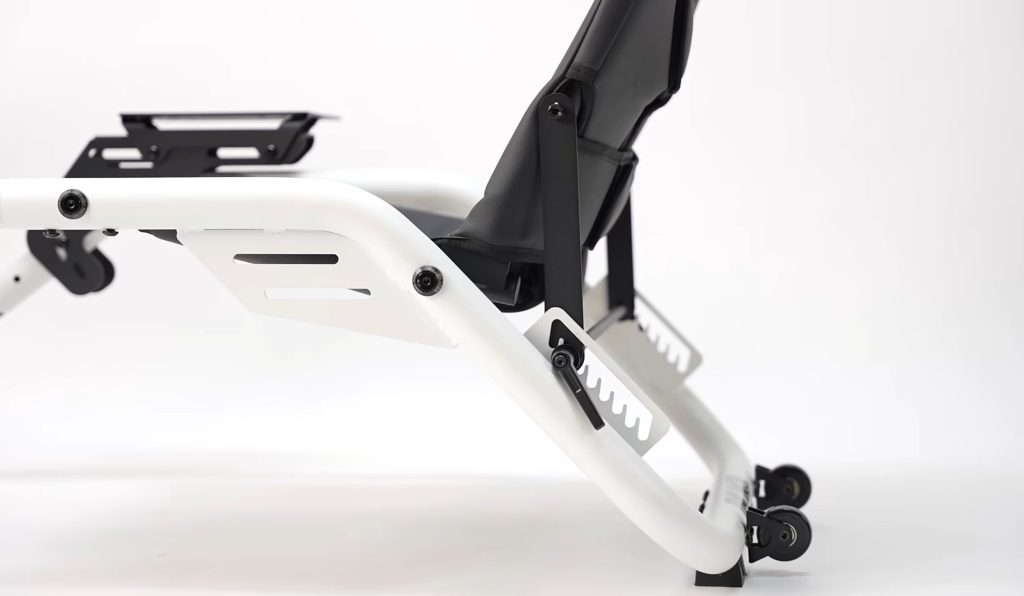
The reclining seat can move from a relatively upright GT position to something considerably more laid back. Combined with the pedal adjustments, you can create anything from a conventional seating position to something loosely inspired by a formula setup.
The wheel deck and pedal tray can both be adjusted for height, angle, and distance. The shifter mount also slides forward and backward, although its height cannot be changed.
Most adjustments require loosening bolts rather than using quick-release mechanisms, so changing positions takes a little time. Trak Racer does include markings around areas such as the pedal tray, which makes repeating a previous position much easier.
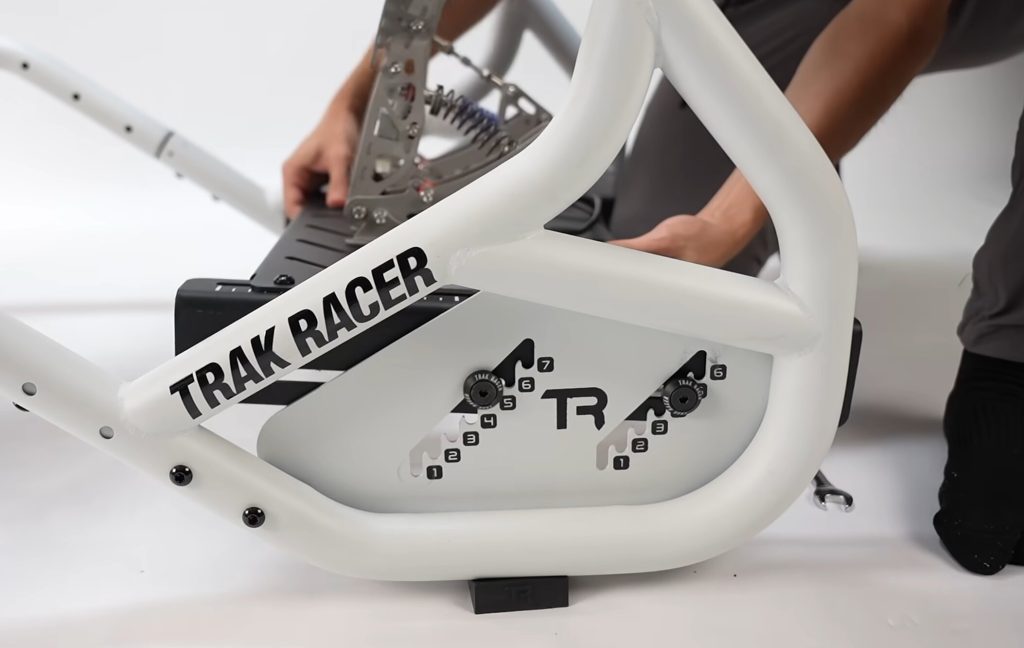
Compatibility is one of the stronger parts of the TR5. The wheel deck uses a broad mounting pattern, the shifter plate works with a wide range of hardware, and the two-piece pedal tray makes installing different pedal sets relatively simple.
I had no significant compatibility problems with any of the equipment I tested. For the entry and mid-range hardware most TR5 owners are likely to use, mounting should be very straightforward.
Trak Racer also offers several accessories specifically for the chassis. These include caster wheels, a cup holder, headphone and VR holder, and an integrated single-monitor mount.
The caster wheels are particularly useful if the simulator needs to be moved regularly. They are sold separately, though, and considering how useful they are on a cockpit like this, I would have preferred to see them included.
The TR5 includes a reclining seat finished in faux leather and microsuede. It does not hold you as tightly as a dedicated fiberglass bucket seat, but it is comfortable and considerably easier to get in and out of.
For longer sessions, the overall comfort was surprisingly good. Ventilation around the lower back could be better, and some heat does eventually build up, but I never found the seat substantially uncomfortable.
There is also enough rigidity for the type of hardware this cockpit is designed around. A proper bucket seat will naturally move less under very heavy braking, but replacing the included seat immediately would reduce some of the value of buying the TR5 in the first place.
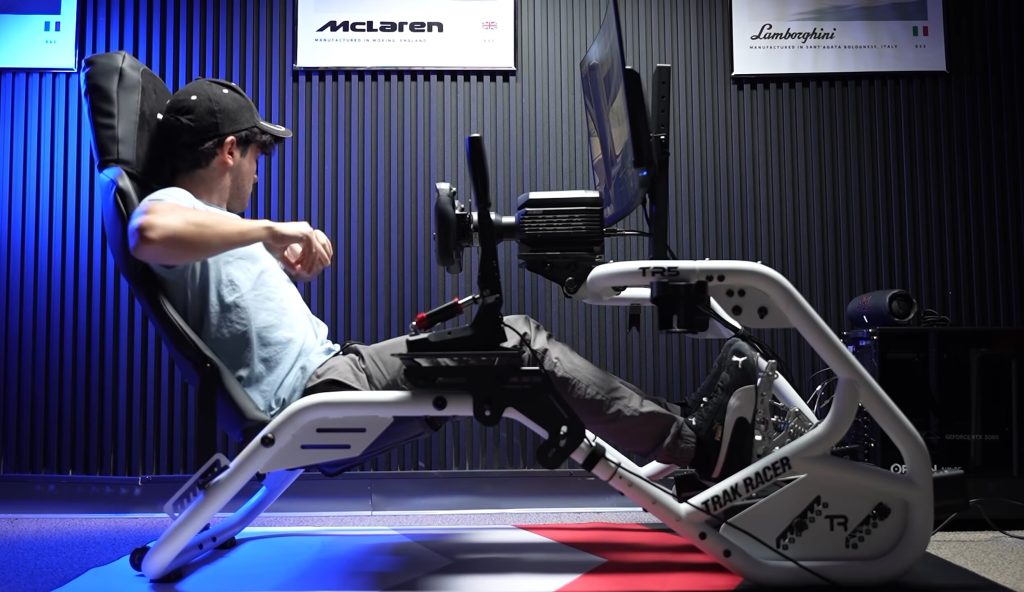
The pedal tray performs well with normal equipment, although it does have limits. I tested it with VRS load cell pedals and could visibly see some flex when applying significant brake pressure.
Interestingly, the movement looked much worse than it actually felt. I rarely noticed it while driving, and it never became significant enough to affect my braking consistency.
A thicker pedal tray would certainly make the structure more rigid. With more typical entry or mid-range pedals, however, I would have very few concerns about it.
Yes, and this was probably the biggest surprise during my testing. I deliberately mounted hardware far beyond what the average TR5 buyer is likely to use, including a Moza R25 producing close to its full 25 Nm.
If you deliberately pull vertically on the steering wheel, there is visible movement through the tubular frame. That type of force is not representative of normal driving, though.
While actually racing with the R25 turned up very high, the wheel structure handled the forces impressively well. There is more movement than you would see from a heavy aluminum profile cockpit, but it was rarely something I actually noticed while driving.
For more common 5 Nm, 8 Nm, 12 Nm, or even stronger mid-range direct drive bases, the TR5 should have plenty of rigidity.
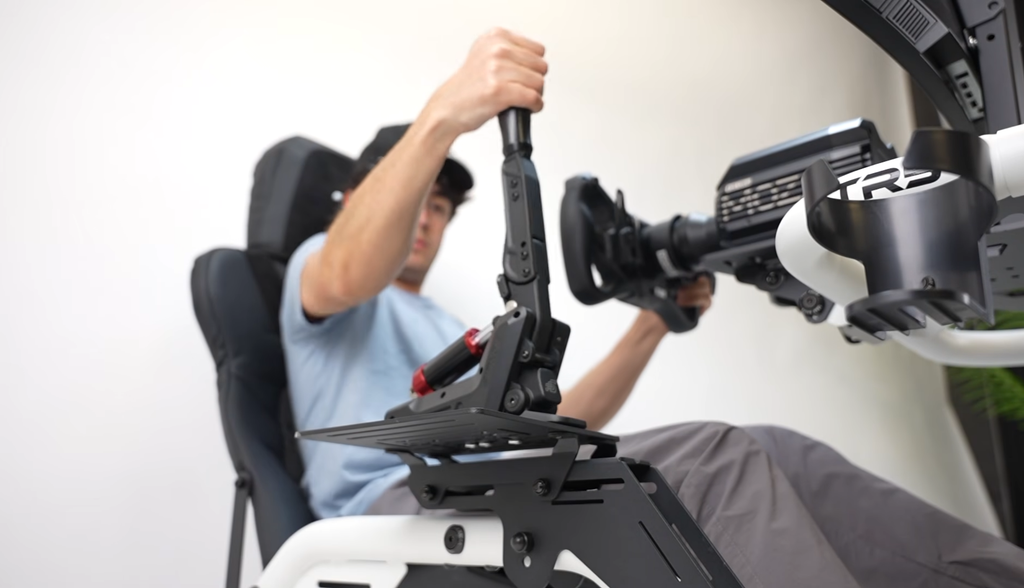
The included shifter and handbrake mount is another area that performs better than its relatively simple construction suggests. I tested it with a fairly substantial Simagic handbrake and repeatedly applied much more force than would normally be necessary.
There is some flex, but it was never particularly noticeable while driving. Hardware such as the Moza HGP, Thrustmaster TH8A, Simagic DS-8X, and similar products should be completely reasonable matches for the chassis.
Trak Racer sells an optional integrated single-monitor mount for around $120. It supports displays up to 50 inches, integrates cleanly with the chassis, and includes a useful cable management insert.
The downside is limited adjustment. Because the display is also connected directly to the cockpit, vibrations from stronger direct drive wheel bases can reach the monitor and cause some visible shaking.
With less powerful hardware, this should be less noticeable. A freestanding monitor stand still provides better isolation and positioning flexibility, while the integrated mount wins on simplicity and appearance.
The white finish looks good, but it can scratch relatively easily while adjustments are being made. Taking a little extra care when loosening and repositioning components is probably worthwhile.
The TR5 is also less modular than a traditional aluminum profile cockpit. You can add Trak Racer accessories and mount plenty of normal sim racing hardware, but profile remains easier to modify if you plan on constantly changing or expanding your simulator.
And while the TR5 can handle surprisingly powerful equipment, there eventually comes a point where moving to aluminum profile simply makes more sense.
The TR5 makes the most sense for someone moving beyond a desk or wheel stand who wants a complete cockpit without dealing with the price, size, and assembly of a larger aluminum profile setup.
For $599, the combination of a seat, chassis, wide adjustment range, solid compatibility, and surprisingly good rigidity is compelling. It also gives you enough headroom to upgrade your wheel base or pedals later without immediately needing to replace the entire cockpit.
If you already own a very powerful direct drive base, extremely stiff pedals, multiple accessories, and expect to continually modify your simulator, aluminum profile remains the more logical route.
For a beginner or mid-range sim racer looking for something complete, comfortable, adjustable, and capable of handling significantly more hardware than its price might suggest, the Trak Racer TR5 is a very strong option.