The PXN Vector X pedals are one of the more surprising recent sim racing launches because I do not think many people expected PXN to make this move yet. Instead of revealing another cheaper entry-level product, the brand has now shown a pedal set that looks far more serious and far more ambitious than what most people probably associate with it.
That is what makes this launch interesting right away. This does not look like PXN slightly dressing up a starter pedal set and hoping people call it premium. It looks more like the company is trying to enter a more competitive part of the market with a load cell brake, heavier construction, more included hardware, and the kind of adjustability buyers in this price range are going to expect. Since these are not properly out yet, the fairest way to cover them is as a what we know so far article.
PXN Vector X Pedals
A real step forward for PXN: strong build quality, a genuinely impressive design and a brake that is the strongest part of the package, held back by throttle and clutch resistance that cannot currently be adjusted.
Best for Buyers who want a pedal set that looks premium, feels solid
Serious pedal set with load cell brake and strong build quality
VERDICT
A real step forward for PXN: strong build quality, a genuinely impressive design and a brake that is the strongest part of the package, held back by throttle and clutch resistance that cannot currently be adjusted.
BEST FOR
Premium-looking solid pedals that perform on track
NOT FOR
Drivers who need adjustable throttle and clutch resistance
What I Like
✓ Strong build and genuinely impressive design
✓ Brake is the strongest part of the package
✓ Smooth, precise throttle and two-stage clutch feel
What I Don’t
✕ Throttle resistance too light and not adjustable
✕ Clutch resistance cannot currently be adjusted
✕ Brake tuning less flexible than elastomer rivals
SETUP Two-pedal set with base plate, plus separate clutch pedal, mountable directly to a cockpit pedal deck
TITLES/EFFECTS TESTED Heavy braking, trail braking, corner exit throttle and partial throttle through longer corners
TUNING Brake spring swapped from red to green in about five minutes, clutch tilt, height, preload and travel available
COMPARED AGAINST Established higher-end pedals, good Hall-effect throttles and elastomer-based competitors
PXN has clearly taken a step forward in design and presentation
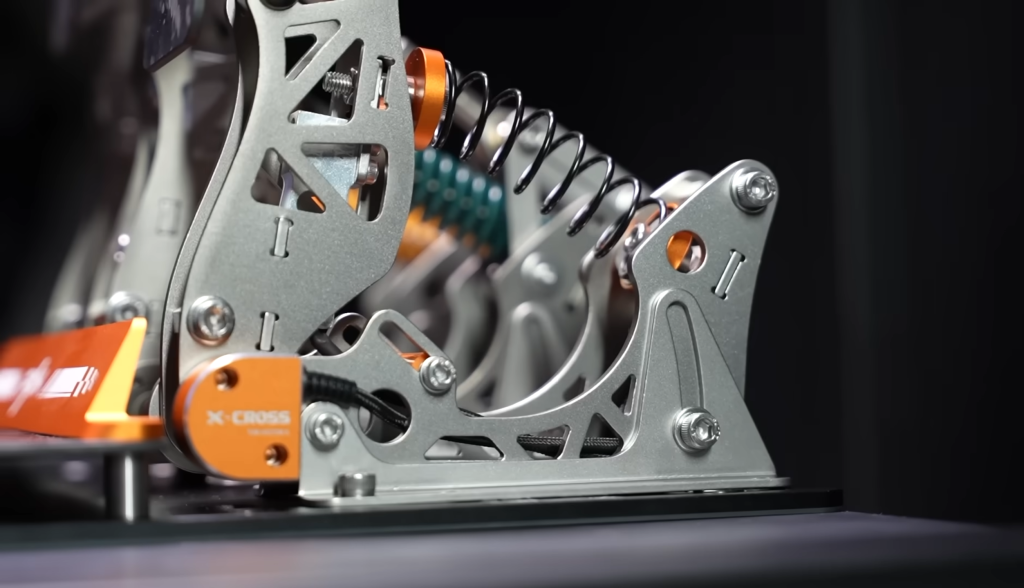
Starting with the overall package, one of the first things worth mentioning is that the standard two-pedal Vector X set already includes quite a lot. You are getting the base plate, the forged carbon footrest, and the aluminum heel plate finished in PXN’s signature orange. Visually, it all comes together very well. Sitting on a rig, the carbon catches the light nicely, and the full set does look much more premium than most people would probably expect from PXN.
That said, I do think there is a small value discussion to be had here. While the included pedal plate is nice, and definitely helps the product feel more complete out of the box, it is also something that many people may not actually need. In my case, the pedals could easily have been mounted directly to a cockpit pedal deck without needing this full base plate at all. Because of that, I do think PXN could make this product more attractive by eventually offering the pedals separately and lowering the entry price for buyers who do not need the full platform underneath.
Even so, there is no denying that the presentation here is strong. The Vector X feels like a properly considered product rather than a rushed attempt to move upmarket, and that alone already says a lot about the direction PXN seems to be heading.
The clutch is surprisingly good, but not fully adjustable where it matters most
Since the clutch is sold separately, it makes sense to start there. The good news is that it is actually very solid. It is made entirely from metal, uses a 3 mm forged carbon fiber face plate, and most interestingly, it comes with a 30 kg load cell sensor combined with a two-stage linkage designed to emulate the bite point of a real clutch. And in use, this works better than I expected.
The first thing I noticed is that the pedal has a good amount of weight to it. In fact, more weight than most clutch pedals I have used, but in this case I actually liked that. Yes, it is heavier than a typical road car clutch, but the two-stage feel is distinct and noticeable, which helps it feel more interesting and more mechanical than the average sim racing clutch pedal. On track, it felt smooth, quiet, and very consistent, and overall I do think PXN has done an excellent job here.
The main drawback is that while there is a decent amount of adjustment in terms of tilt, height, preload, and travel, the actual pedal resistance cannot currently be adjusted. So the fairly stiff feel you get here is simply the feel you get, whether it suits your preference or not. That does limit the pedal a bit, because even though I liked it, a product at this level really should give the user more control over something that important.
The throttle is smooth and precise, but still a little too light
Moving on to the throttle, this is another area where PXN has clearly tried to do something a little more interesting. Build quality remains very strong, the larger forged carbon fiber pedal face looks good, and the mechanism itself uses a bent spring design similar in concept to what you will find on some more established higher-end pedals. It is a visually interesting setup, and more importantly, it does not feel gimmicky.
PXN is also using what it calls Xcross here, which is essentially a dual-sensor system combining a 15 kg load cell with a Hall angle sensor. According to PXN, the point of this is to eliminate distortion and lag while giving the pedal 65,535 points of input resolution throughout its travel. That is obviously a very impressive number on paper, and in actual use, the throttle did feel very smooth, very consistent, and very easy to modulate.
Whether I was feeding in power gently on corner exit, holding partial throttle through longer corners, or making smaller mid-corner corrections, the pedal responded exactly how I wanted it to. That is obviously a good thing. At the same time though, I do want to be honest and say that I did not feel some massive night-and-day difference compared with other good Hall-effect throttles in this price range. The Xcross system seems like a genuine technical benefit, but I would frame it more as an extra layer of confidence and precision rather than something that completely redefines how the pedal feels underfoot.
The bigger issue for me is actually the resistance. Like the clutch, the throttle resistance cannot currently be adjusted, and honestly, it is a little too light. It is not unusable, and once I got used to it, I had no major problem driving with it, but I definitely found myself wishing for more weight. PXN has confirmed that the throttle and clutch resistance are not adjustable right now, though they are reportedly working on a solution, most likely through alternative springs. Until that happens, this remains one of the more noticeable weak points of the set.
Worth knowing: throttle and clutch resistance cannot currently be adjusted.
Xcross throttle: smooth, consistent and easy to modulate on corner exit.
The brake is the star of the show
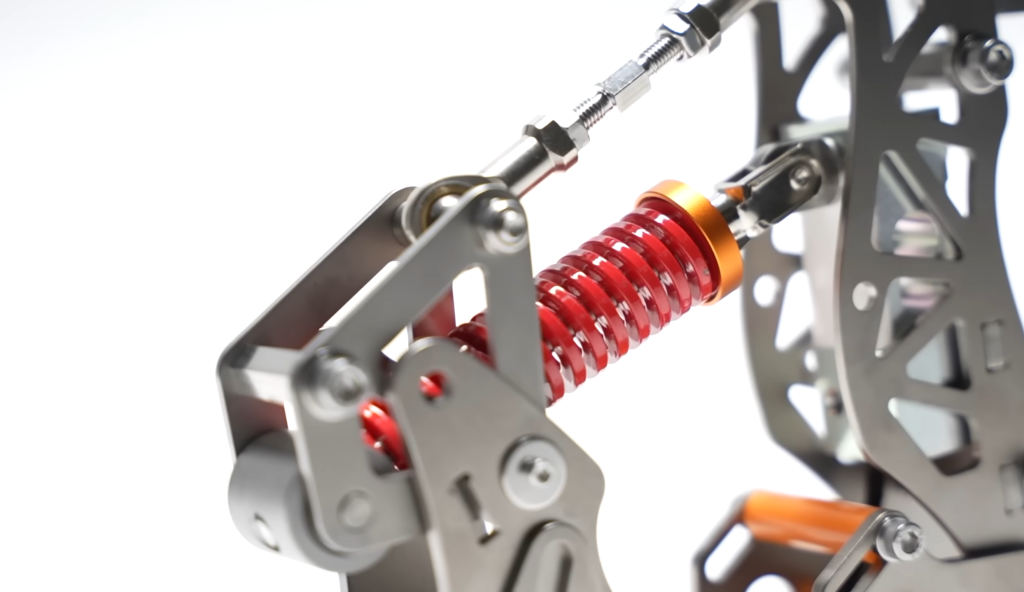
Of course, the brake is the most important part of any serious pedal set, and thankfully this is where the Vector X feels strongest. PXN uses a spring-based braking mechanism paired with an adjustable linkage, and as standard the brake comes with a 200 kg sensor and the lighter red spring installed. That red spring supports up to 125 kg of force, while the included green spring raises that maximum substantially and delivers a much firmer feel.
The takeaway: the brake is the strongest part of the Vector X package.
Swapping the springs is a little tedious and took me around five minutes, which is not the end of the world, but it is not especially elegant either. Still, once I got the stiffer green spring installed, the brake felt very good. Under braking it was firm, stable, confidence-inspiring, and gave exactly the kind of heavy pressure-based feel you want from a more serious pedal set. It did not rely on excessive travel. Instead, it let me build braking force with my leg properly, which made it very easy to trust once I got used to it.
That translated well on track too. Heavy braking zones felt repeatable, trail braking felt natural, and after a bit of adjustment I was able to hit the same braking points lap after lap with good consistency. Just as importantly, the pedal remained perfectly rigid the entire time with no wobble, no noticeable flex, and thankfully no squeaks or creaks either. Even when really leaning on it, the brake felt planted and properly supported.
Another point in its favor is the use of springs rather than elastomers. In the long run, that should help the pedal maintain a more consistent feel, because elastomers can wear down or soften over time. The tradeoff is that fine-tuning is not quite as flexible here. With elastomer-based pedals, you can often mix and match compounds to get a very specific response. Here, meaningful changes mostly come down to swapping the spring itself, and with only two options included, some people may wish for more tuning freedom. Even so, the brake feels very good, and it is easily the strongest part of the Vector X package.
The brake: firm, rigid and repeatable in heavy braking zones.
Final thoughts
So, are the PXN Vector X pedals worth it? Honestly, I think the answer depends on what you value most. As a piece of hardware, PXN has clearly taken a real step forward. These do not feel like entry-level pedals wearing a premium costume. The build quality is strong, the design is genuinely impressive, the brake performs well, and even the clutch feels more interesting than what you usually get in this segment. On top of that, things like the Xcross throttle system, the spring-based brake design, and the control box being ready for future haptic support all show that PXN is trying to build more than just a one-off product.
At the same time, the set is not without compromises. The throttle and clutch both need more resistance adjustment, the brake tuning is less flexible than some elastomer-based competitors, and the included pedal plate, while nice, may not actually be necessary for everyone. So overall, I think PXN has built something that feels genuinely competitive, but also something that still has room to mature.
And that is probably the most interesting thing about the Vector X. It is not perfect, but it also does not feel like a gimmick. It feels like PXN making a real attempt to move into a more serious category, and for the most part, the hardware proves they are capable of doing that. If you want the safest and most established option at this price, there are still other names worth considering. But if you want a pedal set that looks premium, feels solid, performs well on track, and shows where PXN could be heading next, then the Vector X is absolutely worth paying attention to.
FINAL VERDICT
A real step forward for PXN, held back by non-adjustable throttle and clutch resistance.
Ideal buyer: Buyers who want a pedal set that looks premium, feels solid and performs well on track rather than the safest, most established option at this price.
Major drawback: Throttle and clutch resistance cannot currently be adjusted.
Bottom line: It is not perfect, but it is absolutely worth paying attention to if you want premium-looking, solid pedals that perform on track. Code OCRACING takes 5% off at PXN.
Sim racing hardware reviewer and creator. Every review on this site is hands-on tested across direct-drive wheelbases, pedals, cockpits, motion systems and accessories before a word is published.
Simagic is finally preparing to reveal its long-awaited Active Pedal during its global product launch on October 14, nearly two years after the first prototype appeared.
Race Sim Studio has released the Formula Hybrid 2026 for Assetto Corsa, bringing active aerodynamics, a new 350 kW hybrid system, adaptive ERS deployment, and an extensive suite of racing…
Kunos Simulazioni has shared a detailed look at the future of Assetto Corsa EVO, outlining changes to the game's development direction and revealing more information about its long-awaited Free Roam…
Conspit CHS · $369 Conspit sent this product to me for review. Conspit has entered the shifter market with the CHS, a dual-mode shifter that combines a 7-gear H-pattern with…
After making its public debut in Chicago, Sim-Lab is bringing its upcoming Porsche 963 replica steering wheel to SimRacing Expo Frankfurt for another major showcase.
Gran Turismo 7 Spec IV Part 1 arrives October 15 with Sportsland SUGO, six new cars including the Ferrari F355, new Brand Central challenges, Car Concierge, Car Viewer and more.
The new Thrustmaster T-GT III brings Direct Axial Drive, 5 Nm of constant torque, load cell pedals, and dedicated Gran Turismo 7 haptics to PS5 and PS4.
The Circuit One D Force 1 packs four motion actuators into a suitcase, installs in about 10 minutes, and trades big travel for detail you can actually use.