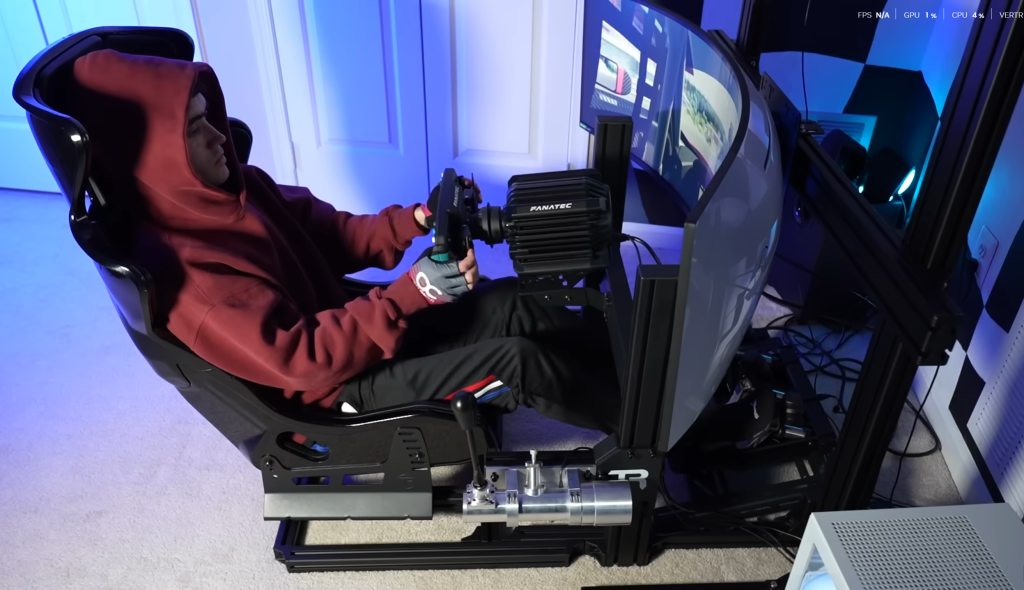
The Trak Racer TR40S is the company’s most affordable aluminium profile cockpit ever. It keeps things simple and straightforward while offering the adjustability, stability, and long term upgrade potential that people usually expect from far more expensive rigs. It is very clear that this chassis aims to give you the core benefits of an aluminium profile setup without the usual premium price tag, and based on my testing, it succeeds at that more often than not.
Before we go deeper, it is important to highlight something many buyers overlook. The heavily advertised price of around 340 dollars includes the chassis only. Once you add the optional Trak Racer bucket seat, which I have here, the total jumps to almost 800 dollars because that seat alone retails for about 420 dollars. With that said, both pieces deserve their own separate look.
Verified purchase options at lowest current prices:
COMPARED AGAINST: SimLab GT1 Evo and Next Level Racing F-GTBENCHMARK: Wheelbase force at around 12 Nm
Seat Design and Comfort
Trak Racer’s newest GT style fiberglass bucket seat is without question one of the more unique looking options in this part of the market. Most sim racing seats look nearly identical, so it is refreshing to see something with a more distinct design. The shell is entirely fiberglass and the padding is made from a slightly firmer high density foam rather than the softer memory foam Trak Racer uses in some other seats.
Comfort is decent for a fixed bucket. It keeps me planted, the bolstering works well, and the overall shape does a good job at maintaining a sense of immersion. It is not the most comfortable seat I have ever used though. For example, I still prefer Trak Racer’s own rally seat, and anyone who wants long session comfort may want to explore third party options like Sparco or OMP alternatives. Thankfully, the TR40S supports universal seat mounts, so swapping to your own seat is simple and often cheaper.
The seat also has zero flex. The fiberglass shell is solid and does not move, which adds confidence when driving aggressively.
Chassis Rigidity
The TR40S uses 4040 aluminium profile for its main frame. It is thinner than the 4080 profiles found on higher end rigs, but Trak Racer compensates for some of that with large corner brackets and solid mounting plates. Under normal driving, even when using high end hardware, the rig holds up better than I expected for the price.
There is some movement though. At around 12 Nm of force on my wheelbase, the rig does show signs of vibration throughout the frame. It is not severe and did not hurt my experience, but it is noticeable if you have used stiffer rigs before. The most obvious flex happens when pushing and pulling on the wheel rim. To be fair, that is not a natural driving motion, yet the movement is still there.
More important is the flex under heavy braking. The midpoint of the frame gives slightly under load, something I have also seen in other 4040 based rigs. It is not dramatic, but you can feel it. On the positive side, the pedal plate itself is impressively firm. There is virtually no flex coming from that section, even with high load cell pedals.
The takeaway: a firm pedal plate, solid build quality and included mounts make this budget 4040 rig feel far more capable than its price suggests.
Shifter Mount and Accessories
The included shifter mount is not fancy, but it is rigid enough to support heavy shifters like the BDH1 which I mounted during testing. There was no creaking or bending, which is a pleasant surprise at this price point. Many competitors make you pay extra for a shifter and handbrake mount, so it is nice to see it included here.
Trak Racer also includes additional plates that make handbrake mounting easier. For beginners or budget users building their first full setup, these small details add a lot of value.
Build Quality and Adjustability
Although the TR40S is one of the more barebones rigs Trak Racer offers, the build quality is still solid. The aluminium profile arrived without a scratch, the black powder coating looks clean, and everything fits as expected. Trak Racer is known for consistent machining, and this cockpit continues that trend.
Adjustability is one of the main reasons people upgrade to aluminium profile rigs in the first place, and the TR40S gets this right. You can adjust:
Wheel height, angle, and distance
Pedal height, angle, and distance
Shifter height and tilt
Seat position and seat angle (with upgraded brackets)
Adding a seat slider improves things significantly and I highly recommend it. At around 50 dollars, it makes daily use of the cockpit much easier, especially if you are sharing the rig with family or friends.
Expandability is also a major advantage. Trak Racer sells an integrated monitor stand that mounts directly to the rig. Third party companies like ModdedSim offer extras such as cable management clips, cup holders, phone mounts, and accessory trays. Aluminium profile rigs thrive on customization, and the TR40S fits nicely into that ecosystem.
Seating Position and Daily Use
One thing that surprised me was how low this cockpit sits. The default seating position is somewhere between GT and formula. It is comfortable enough once you are in it, but getting in and out of the rig can be awkward because of how low everything is to the ground. This is not a deal breaker, but it is worth knowing.
Worth knowing: the advertised price of around $340 covers the chassis only, and the low seating position can make getting in and out awkward.
Final Thoughts: Solid Entry Level
Considering the price, what it offers, and who it is designed for, the Trak Racer TR40S is a very respectable entry level aluminium profile cockpit. Ignoring the expensive optional seat, the base chassis alone delivers solid performance for its cost and opens the door to the world of adjustable, expandable aluminium rigs without forcing you into a premium budget.
Price history
A$449.00~$313.37at Trak Racer AUUnchanged over 90 days
Range
$295.81 – $324.25
Typical
$316.93
Readings
84
Retailers
4
Tracking since
21 Dec 2025
Last checked
14 Oct Trak Racer AU
84 readings so far — not daily. · Sale prices predate daily tracking.
Tracked daily across every shop we follow+Add to build
Compared to something like the SimLab GT1 Evo, the TR40S is not as rigid or as heavy duty, but it is also significantly more affordable and still delivers enough stability for entry to mid-range wheelbases. Against a tubular rig such as the Next Level Racing F-GT, the TR40S generally offers better upgrade potential and cleaner adjustability, while the F-GT counters with multiple driving positions and a more enclosed feel. For beginners wanting their first serious upgrade, or experienced sim racers looking for a budget-friendly secondary rig, the TR40S makes a strong case for itself.
At $313.37 this is its usual price.
The lowest we have recorded is $295.81 on 26 Feb 2026.
It has flaws, but at this price, it also delivers far more than I expected.
FINAL VERDICT
Recommended. Considering the price, what it offers, and who it is designed for, the Trak Racer TR40S is a very respectable entry-level aluminium profile cockpit.
Ideal buyer: Beginners wanting their first serious upgrade
Major drawback: Frame vibration at around 12 Nm and midpoint flex under heavy braking.
Bottom Line: It has flaws, but at this price, it also delivers far more than I expected.
Sim racing hardware reviewer and creator. Every review on this site is hands-on tested across direct-drive wheelbases, pedals, cockpits, motion systems and accessories before a word is published.
Simagic is finally preparing to reveal its long-awaited Active Pedal during its global product launch on October 14, nearly two years after the first prototype appeared.
Race Sim Studio has released the Formula Hybrid 2026 for Assetto Corsa, bringing active aerodynamics, a new 350 kW hybrid system, adaptive ERS deployment, and an extensive suite of racing…
Kunos Simulazioni has shared a detailed look at the future of Assetto Corsa EVO, outlining changes to the game's development direction and revealing more information about its long-awaited Free Roam…
Conspit CHS · $369 Conspit sent this product to me for review. Conspit has entered the shifter market with the CHS, a dual-mode shifter that combines a 7-gear H-pattern with…
After making its public debut in Chicago, Sim-Lab is bringing its upcoming Porsche 963 replica steering wheel to SimRacing Expo Frankfurt for another major showcase.
Gran Turismo 7 Spec IV Part 1 arrives October 15 with Sportsland SUGO, six new cars including the Ferrari F355, new Brand Central challenges, Car Concierge, Car Viewer and more.
The new Thrustmaster T-GT III brings Direct Axial Drive, 5 Nm of constant torque, load cell pedals, and dedicated Gran Turismo 7 haptics to PS5 and PS4.
The Circuit One D Force 1 packs four motion actuators into a suitcase, installs in about 10 minutes, and trades big travel for detail you can actually use.