Setup RacGTing Challenger 301 with a Moza R9 9 Nm direct drive wheelbase, load cell and entry-le
The RacGTing Challenger 301 is a foldable, ultra-portable sim racing cockpit designed for newcomers entering the hobby with limited space and a tighter budget. With a retail price of around 200 dollars and frequent discounts, this cockpit targets entry level racers using mainstream gear and looking for a simple way to get started without committing to a large static rig. Naturally, I did the most logical thing possible and mounted a 9 newton meter direct drive wheelbase to it to see how far it could be pushed.
Below is my full breakdown of what I like, what falls short, and who the Challenger 301 is really made for.
Foldable, ultra-portable sim racing cockpit for newcomers with limited space and a tighter budget
VERDICT
Its price, foldable design, and modest rigidity make it a strong option for newcomers who need a compact solution and do not plan on driving with high end pedals or very powerful direct drive wheels.
BEST FOR
Newcomers in small spaces on entry level gear
NOT FOR
Drivers planning heavy load cell pedals or powerful direct drive wheels
WHAT I LIKE
Foldable, ultra-portable design for small spaces
Around $200, often dipping lower in sales
Handled my Moza R9, a 9 newton meter direct drive wheelbase surprisingly well
WHAT I DON’T
Pedal tray separated from its latch points under heavy load cell braking
Plenty of flex if you aggressively tug the wheel or push sideways
Shifter mount fixed at a specific angle with no adjustment
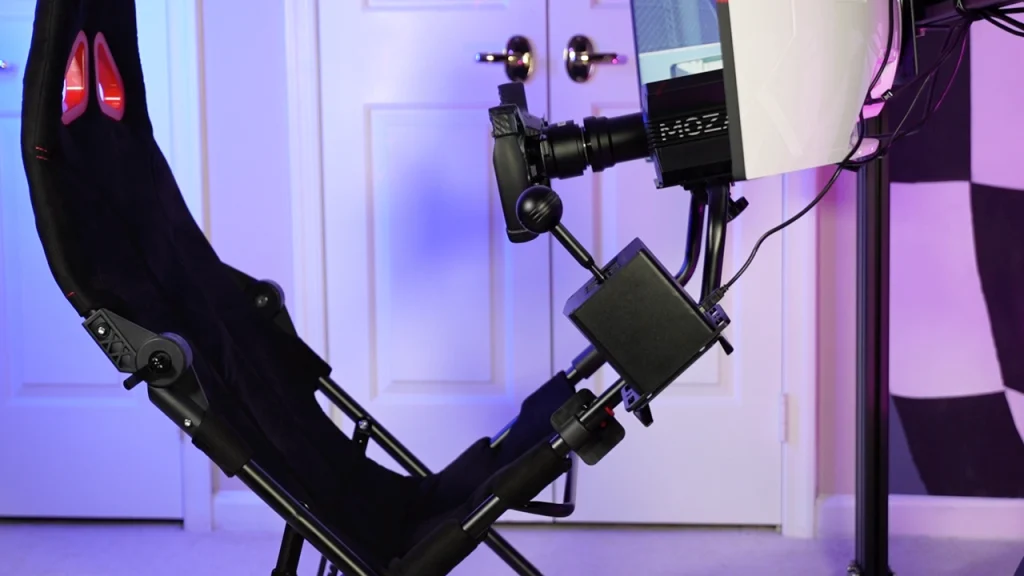
SETUPRacGTing Challenger 301 with a Moza R9 9 Nm direct drive wheelbase, load cell and entry-level pedals, and a resistance-heavy H-pattern shifter
Pricing
As a budget focused cockpit the Challenger 301 sits consistently around the 200 dollar mark, often dipping much lower during major sale periods. Because RacGTing tends to run aggressive promotions, and because many discounts can stack, this is one of the more affordable foldable rigs on the market. It is priced similarly to offerings like the Next Level Racing GT Lite, and significantly cheaper than more advanced foldable frames or hybrid entry rigs that lean closer to mid range pricing.
The important takeaway is that the Challenger 301 is priced exactly where an entry level foldable rig needs to be. It exists to serve a specific purpose in the sim racing landscape, and the price reflects that perfectly.
The takeaway: At around $200, the Challenger 301 is priced exactly where an entry level foldable rig needs to be.
Build Quality
The Challenger 301 is designed with portability as its primary objective, so the structure is built from lightweight steel tubing paired with a foldable suede style seat. The seat does have some permanent creasing because of the folding mechanics, but once you sit in it, it is comfortable enough for racing sessions. The added red stitching is a nice touch, and while the padding is basic, it gets the job done.
As expected at this price, the seat lacks the breathable materials or reinforced cushion design found on premium cockpits, but the overall package still looks cleaner and more put together than many generic portable rigs.
The mounting plates for the wheel, shifter, and pedals are also standard for this category. You can mount nearly all mainstream gear without issue, although heavier hardware will highlight the limits of the frame. For beginner setups the rigidity is reasonable, and the overall build quality matches its pricing.
Adjustability
Adjustability is limited but usable. You can tilt the wheel deck, slide the pedal tray forward or backward, and slightly recline the seat. The shifter mount is fixed at a very specific angle which reminded me of a Carrera GT placement. It is amusing, but not ideal for ergonomics.
Higher end cockpits offer far more adjustment, but that level of refinement simply cannot coexist with a frame designed to fold up. Instead, the Challenger 301 prioritizes quick storage and small-space usability. For someone racing beside a desk or in the middle of a living room, that tradeoff makes perfect sense.
On-Track Performance
Climbing in and out is technically done by lifting the right side of the wheel deck, though once everything is mounted and cable managed, I found slipping in from the top to be faster. Once seated, performance varies depending on the hardware you attach.
Pedals
This is the component that exposes the Challenger 301’s limits the most. Initially I attempted to use high end load cell pedals, but one heavy braking input was all it took for the pedal tray to separate from its latch points. As soon as that happened, I immediately swapped to softer, non load cell pedals which are clearly what this cockpit is designed for.
Worth knowing: One heavy braking input was enough for the pedal tray to separate from its latch points with high end load cell pedals fitted.
With entry level pedals the tray holds up fine. If someone really insisted on using more demanding pedals, reinforcement is possible with DIY modifications, but at that point a more substantial cockpit would make more sense.
Wheelbase
Despite being made for modest gear, the cockpit handled my Moza R9, a 9 newton meter direct drive wheelbase surprisingly well. There is plenty of flex if you aggressively tug the wheel or push sideways, but under normal use I could still feel a lot of the detail and nuance that the wheelbase offers. Yes, some fidelity is lost through the flex of the frame, but it was completely usable and much better than I expected.
For beginner gear like a G923, T128, or T248, the rigidity is totally appropriate, and the rig performs much better than the price would imply.
Shifter Mount
Using a resistance heavy H pattern shifter made it clear that I was pushing past the cockpit’s comfort zone. The mount flexes noticeably when shifting through the gates, though it still worked. With lighter shifters from beginner ecosystems, it would likely perform without issue. The inability to adjust the angle, paired with the awkward built in tilt, limits its ergonomics, but it can be placed on either side which helps.
Final Thoughts: A Smart Starter Rig for Small Spaces
The RacGTing Challenger 301 exists for a very clear audience. Its price, foldable design, and modest rigidity make it a strong option for newcomers who need a compact solution and do not plan on driving with high end pedals or very powerful direct drive wheels.
If you value portability, have limited space, and are running entry to mid range hardware, it is an easy product to recommend. It holds up better than expected and offers an approachable way to enter the sim racing world without overspending or dedicating an entire room to the hobby.
However, if you know upgrading to heavier, more demanding gear is in your future, or if you do not need portability at all, a more robust cockpit will provide better long term value.
FINAL VERDICT
Recommended for newcomers who value portability and have limited space. If you value portability, have limited space, and are running entry to mid range hardware, it is an easy product to recommend.
Ideal buyer: Newcomers with limited space running entry to mid range hardware
Major drawback: Pedal tray separates under heavy load cell braking, with frame flex under demanding gear
Bottom line: It holds up better than expected and offers an approachable way to enter the sim racing world without overspending or dedicating an entire room to the hobby.
Sim racing hardware reviewer and creator. Every review on this site is hands-on tested across direct-drive wheelbases, pedals, cockpits, motion systems and accessories before a word is published.
Simagic is finally preparing to reveal its long-awaited Active Pedal during its global product launch on October 14, nearly two years after the first prototype appeared.
Race Sim Studio has released the Formula Hybrid 2026 for Assetto Corsa, bringing active aerodynamics, a new 350 kW hybrid system, adaptive ERS deployment, and an extensive suite of racing…
Kunos Simulazioni has shared a detailed look at the future of Assetto Corsa EVO, outlining changes to the game's development direction and revealing more information about its long-awaited Free Roam…
Conspit CHS · $369 Conspit sent this product to me for review. Conspit has entered the shifter market with the CHS, a dual-mode shifter that combines a 7-gear H-pattern with…
After making its public debut in Chicago, Sim-Lab is bringing its upcoming Porsche 963 replica steering wheel to SimRacing Expo Frankfurt for another major showcase.
Gran Turismo 7 Spec IV Part 1 arrives October 15 with Sportsland SUGO, six new cars including the Ferrari F355, new Brand Central challenges, Car Concierge, Car Viewer and more.
The new Thrustmaster T-GT III brings Direct Axial Drive, 5 Nm of constant torque, load cell pedals, and dedicated Gran Turismo 7 haptics to PS5 and PS4.
The Circuit One D Force 1 packs four motion actuators into a suitcase, installs in about 10 minutes, and trades big travel for detail you can actually use.